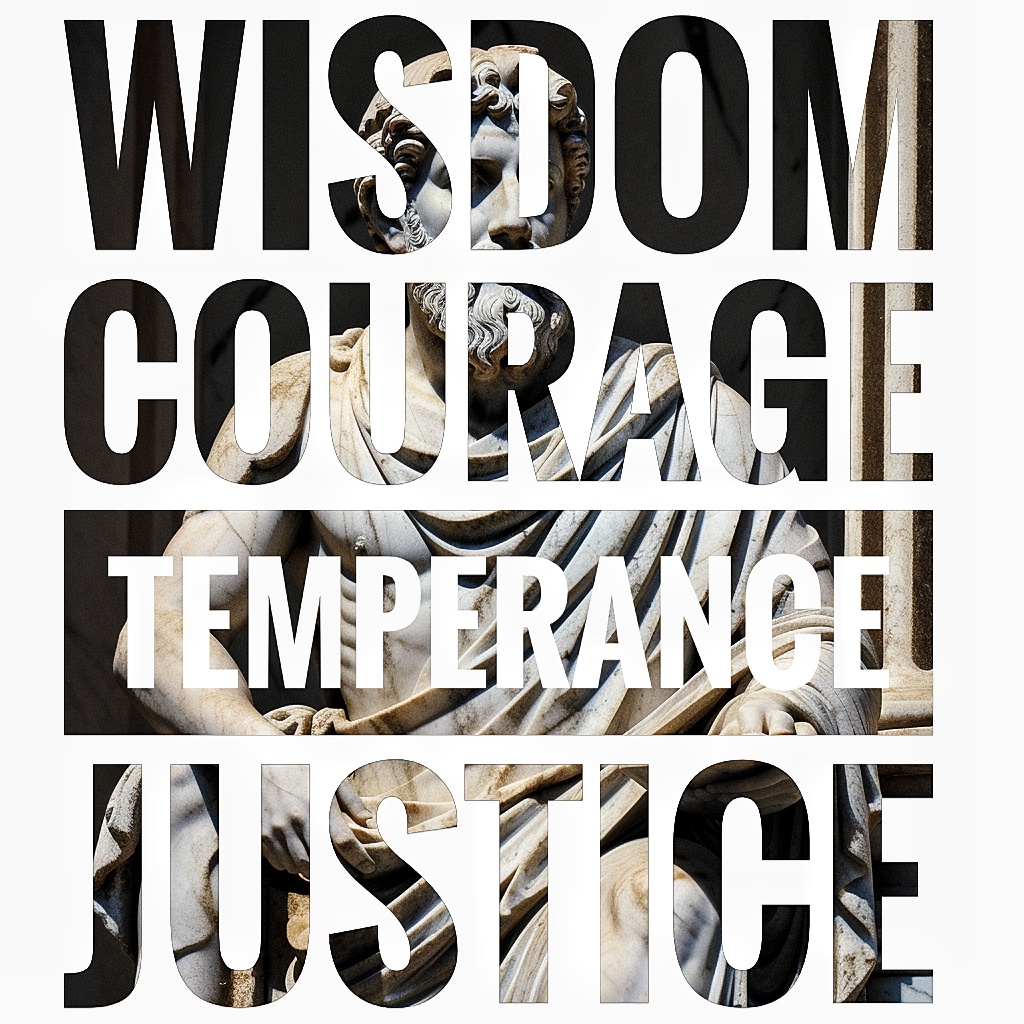
If you have never had a direct explanation of what Stoicism is, or how its gauged, then you should always look for the basic core principles that every single ideology should have. With Stoicism, the “core” virtues are very clearly explained and originally derived from Socrates who wrote about his belief that virtues, as we know them today, are just different aspects of a persons character. We get the four “core” virtues of Stoicism this way. With the first being Wisdom.
Why wisdom?
Wisdom is the “chief good” according to Socrates and and it is the only human ability that is all applicable under every circumstance. Without wisdom we cannot function in our lives ethically, or morally. We must cultivate wisdom whenever possible. We do so by educating ourselves, but more importantly, experiencing life and accept reality.
Wisdom: Cognitive strengths that entail the acquisition and use of knowledge, examples include creativity, curiosity, judgement, and perspective (providing counsel to others).
Courage
Not just in the traditional sense, as we would normally apply this virtue, on the battlefield or in physical trials, but the “core” virtue that we must all possess in order to become a better version of ourselves. We must utilize courage whenever we have a hurdle, an obstacle to any challenge that we must focus and act against other influences to succeed.
Courage: Emotional strengths that involve the exercise of will to accomplish goals in the face of opposition, external or internal; examples include bravery, perseverance, and authenticity (honesty).
Temperance
Anything done to excess is operating beyond the scope of your ability, too much sugar will eventually hurt your teeth and organs. We must accept that there is only so much that we should do and only so much that we must do. Discipline is one of the “core” tenants of the virtue of Temperance. If you want to know what discipline looks like, go read David Goggins Book – Can’t Hurt Me. There are other aspects to Temperance however and we must strive to develop and facilitate those aspects as they will only further develop out character.
Temperance: Strengths that protect against excess; examples include forgiveness, humility, prudence, and self-control.
Justice
While we have a court system that we depend on for litigation of everything that cannot be easily resolved between people, we must accept that civility is part of how we work through our lives. We are social creatures, and while the ancient stoics knew this well, they could not imagine the current level of connectivity we possess through social media. We find ourselves constantly making decision about the right way to act, respond, and consume, content online, this is a very important virtue to examine and understand in this context.
Justice: Civic strengths that underlie healthy community life; examples include fairness, leadership, and citizenship or teamwork.
The above direct definitions are from Massimo Pigliuccui’s book “how to be a stoic” and in one of the chapters about the “core” virtues he adds two more.
Humanity: Interpersonal strengths that involve “tending and befriending” others; examples include love and kindness.
Transcendence: Strengths that forge connections to the larger universe and thereby provide meaning; examples include gratitude, hope, and spirituality.
In my opinion, Humanity and Transcendence fall into the other virtues, Humanity into Justice and Transcendence into Wisdom. The last two virtues were added due to a study called “Shared Virtue: The Convergence of Valued Human Strengths Across Culture and History” (PDF Link) This study covered the main religions of humanity and the authors found that these are the six “core” virtues that are constantly, and consistently, present throughout the majority of them.
Does modern Stoicism have a proponent of religiosity? Are the “core” stoic virtues dependent on a theological component? It is an interesting mental exercise.
Think about it…







 Secønd Støic
Leave a comment