
A life oriented around honor does not wait for the best time to act against unfavorable odds. The civilians and first responders at Bondi Beach advanced toward gunfire. They embody a principle that defies utilitarianism’s neat constraints. They moved, not because the math favored success, but because inaction would have constituted an unbearable dereliction of being. On display was the pinnacle of moral integrity as it highlights that when the system fails, you adopt the system’s role in taking action. The line is drawn, not in statistics or legislation, but in the individual consciousness that has accepted its righteous duty to act.
To step forward into chaos while unarmed is to affirm that self-preservation alone cannot anchor a meaningful existence. In that instant, the distinction between moral and physical courage collapses, it’s when you accept that you are both the line and the sacrifice. The knowledge that your probability of survival is nearly zero does not cancel your obligation, in retrospect your life is defined by it. A Stoic-minded person does not flee from inevitability but transforms fate into form and death into decision. It is a calculus of being rather than outcome.
The impediment to action advances action. What stands in the way becomes the way – Marcus Aurelius
Bondi Beach was thus not an incident merely of terrorism but of choice. Every movement toward danger was a refutation of nihilism, a declaration that even in a deterministic universe governed by blind physical law, agency over self persists in defiance. These civilians did not act because they misjudged their chances, the contrary, they acted because they judged their lives to mean less if they failed to act. The logical endpoint of morality, stripped of reward or protection, is the will to confront annihilation with dignity.
A rational mind recognizes futility with sharp precision, and yet morality and honor, demand that we stand within it. The Stoics would argue that the virtue lies not in success but in alignment with reasoned duty and that which is right must be done precisely when it cannot be done effectively.
Just that you do the right thing. The rest doesn’t matter. Cold or warm. Tired or well-rested. Despised or honored – Marcus Aurelius
This paradox is the ethical compulsion to face impossible odds, and certain death becomes the crucible in which righetous character is forged. To retreat into comfort or statistical expectation is to deny one’s autonomy as a moral agent, seeking honorable destinations.
Given this context, the civilians who engaged the Bondi Beach terrorists acted within the logic of the logos, the rational structure of duty independent of outcome. They confronted a statistically astronomical certainty of loss, from a situation they did not initiate but suddenly found themselves involved in. Yet in that instant of decision, they were no longer citizens of a disarmed nation or obeying evolutionary self-preservation. They manifested into agents of honor and principle. Logic, in its pure form, does not oppose moral action, on the contrary, it decisively refines it. The clarity of danger strips away illusion, leaving only the binary truth of will. As a mechanism of human function, you will either fight, flee, or freeze. We are all hard wired for these three responses.
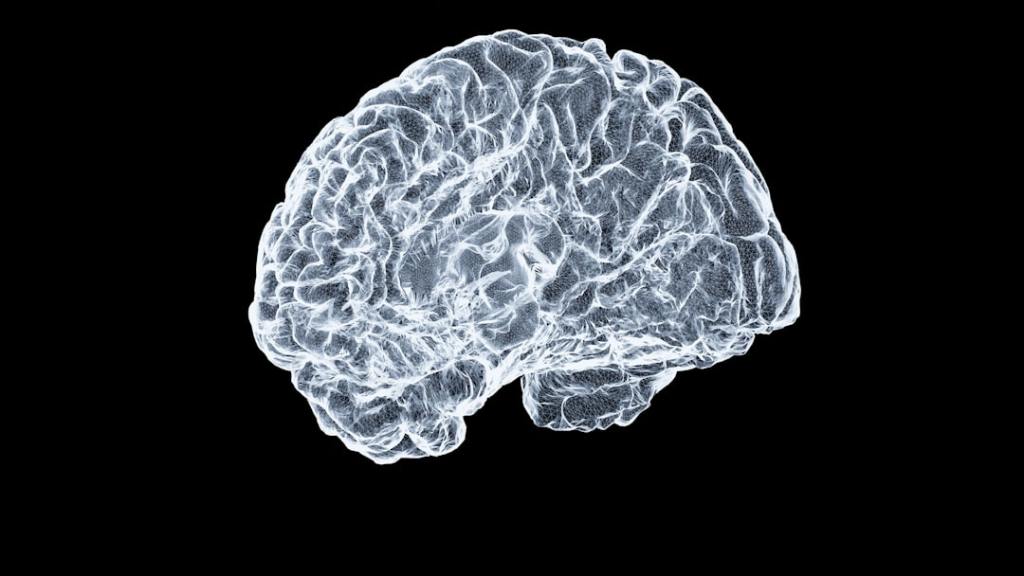
Neuroscience offers a brutal clarification of our individual temperament summed up from genetics. Each person’s stress response is partly written into the COMT gene. It is known as Catechol‑O‑Methyltransferase. This gene governs how efficiently the brain clears dopamine from the prefrontal cortex. The two main allelic variants, Val158Met, create a behavioral dichotomy. Ancient philosophy would have recognized this as the difference between the man of action and the man of reflection. The Val/Val carriers degrade dopamine rapidly, producing a lower baseline of cortical dopamine but preserving executive function under acute threat. The Met/Met carriers clear dopamine slowly. They enjoy enhanced working memory and analytical depth at rest. However, they suffer cognitive overload when stress spikes. Combat and contemplation, encoded within humanity, separated only by subtle amino acid substitution.
Evolution never standardizes, it intentionally diversifies for survival. The “warrior” genotype thrives in the high-stakes environments where quick acts override deliberation. The “worrier” genotype excels in stable contexts where building systems, language, and foresight guide them under pressure. Under Darwinian logic, both persisted because each balanced the other. Civilizations require architects and soldiers. They need thinkers and doers. Worriers are necessary to prevent risk and warriors to absorb it. The tragedy of modernity is that our environment often reverses their proper domains. Those governed by reflective caution dominate the actionable decisions. In contrast, those tuned for kinetic courage are marginalized until catastrophe demands them, which is when they shine.
Both the warrior and the worrier share the same fate; only one has learned to command his mind. That is the only victory the Stoic recognizes.
And yet, no genome commands the soul. The ancient Stoics frame existance to stabilize these temperamental extremes. It teaches the slow blooded how to move through panic without collapse. It guides the fast blooded on how to channel aggression without corruption. Neurochemistry defines probability, not destiny. The COMT enzyme may determine whether one’s hands tremble in battle, but only principle determines whether one’s feet advance. Biology supplies potential and virtue converts it into functional honor.
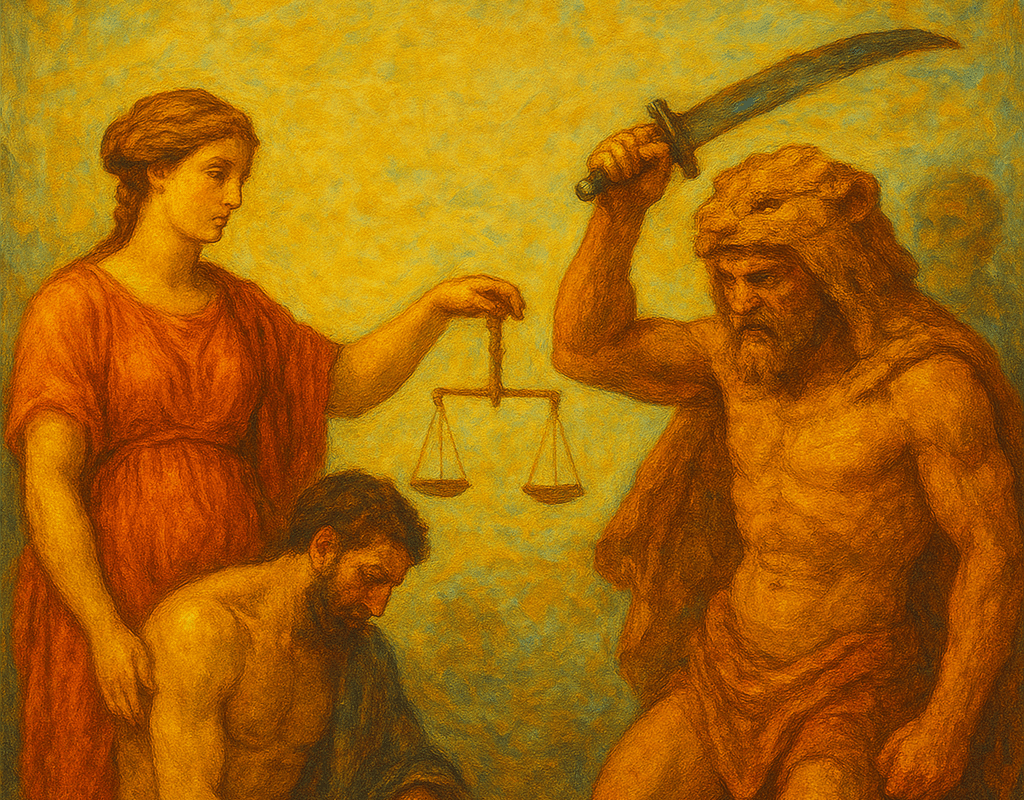
To act, knowing you will likely fail, grants existence a strange coherence. Within defeat lies a type of liberation, a Nietzschean transcendence beyond fear and expectation. Those moments collapse the hierarchy of values, and as such survival becomes secondary to meaning. The unarmed act. To do nothing is to surrender, not of the body ,but of the moral architecture that defines humanity itself.
“To disarm the people… is the most effectual way to enslave them.” – George Mason (1788)
Australia’s gun laws render heroism structurally necessary, but ultimately difficult. The legal framework does not consider self-defense a valid reason for firearm ownership. Yet when violence infiltrates such a system, it leaves individuals with no tools except virtue and physical courage. This creates an asymmetry where the aggressor, unrestricted by morality or legality, holds every material advantage. Then the righetous actor, stripped of means, must rely entirely on character.
This situation was both a triumph of civilization and an exposure of its fragility. A society that externalizes responsibility for safety onto the state implicitly assumes the state can be omnipresent. When that illusion fails, as it did at Bondi Beach, the raw truth of human vulnerability returns. No law protects you when the first shot is fired. At that moment, moral infrastructure becomes the only functioning weapon. The Stoic accepts this not with despair but with preparation. The weapon is the will. A person with a well-developed mindset will have anticipated this possibility. They will have acted appropriately before such events.
This disarmament is not only physical but existential. To ban a necessary tool shows ultimate faith in the compliance of evil. Such faith is always misplaced. Where weapons are absent, virtue must be sharpened to equal intensity. The cost of delegating all power to the state is that individuals must become philosophical warriors in its absence.
Within the United States, firearm discourse hinges on opposing interpretations of freedom and safety. Some empirical studies claim armed civilians reduce mass-casualty duration significantly, where others reveal statistical noise or negligible difference. But logic requires discipline and one cannot select data to preserve one’s worldview. A recent study from crimeresearch.org “Massive errors in FBI’s Active Shooting Reports from 2014-2023 regarding cases where civilians stop attacks: Instead of 4%, the correct number is at least 35%. Excluding gun-free zones, it averaged over 51.5%.” The reality of such situations does not change because of intentionally drawn maps. These maps separate societies. They do not change human nature. More simply stated, it is better to have the potential for a good guy with a gun to intervene. Good guys with guns are the only ones who stop these situations.
“When a life-threatening crisis strikes and seconds count, the real first responders are the citizens present.” – Massad Ayoob (1974)
If the U.S. example illustrate distributed resistance through capability, Australia’s demonstrates resistance through sacrifice. Both reflect the same principle, refracted through circumstance, that when law or weapon fails, morality remains the last defense. The goal is not to valorize violence. Instead, it’s to accept that existential readiness is crucial. Acting rightly when statistics predict annihilation is the essence of being moral, and seeking honor, in a chaotic world.
The Stoic View
Stoicism demands we distinguish control from outcome. The moral universe does not promise safety, it promises agency over self. When an individual runs into danger, knowing they may die, they reclaim authorship of their story. That logic infuriates the materialist but gratifies the philosopher. Life ceases to be about survival and becomes about alignment with principle. The Bondi Beach heroes lived that axiom in blood.
The rationalist might object that If death is certain, why act? The answer is that righetousness itself depends on acting regardless of certainty. Without that ability to choose against fear, all ethics collapses into biological determinism, which is the herd instinct of self-preservation. In that frame, courage is not the denial of death, it is its domestication. You make mortality obey, briefly, your own terms.
Momento Mori – remember you must die
“You could leave life right now. Let that determine what you do and say and think” – Marcus Aurelius
Bondi’s fallen proved this truth in the harshest way. Rabbi Eli Ben‑Shimon died shielding children as he tried to lead them away from the gunfire. Boris Gurman and his daughter Sofia charged at one of the attackers with nothing but instinct and defiance. A surf lifesaver, Luke Hammond, sprinted through open ground to drag the injured behind cover and did not return. These are not martyrs in the religious sense, but philosophers of action, their bodies became arguments that courage cannot be legislated or delegated. The goal is not survival, but inner coherence. A person aligned with true virtue cannot be defeated, only transformed. In their final seconds, they took righteous action, and we should all be so fortunate.
Every high profile example of government failure highlights terrorist attacks on the defenseless. These actions shine a spotlight on those responsible. They also reveal those who entered the battlefield to do what is right, not just to survive the ordeal. Ahmed al-Ahmed was shot five times, and attacked one of the terrorists disarming him, as of this article he is still in the hospital healing. Ahmed survived where others fell, and he will live the glory of such actions, just as Detective Senior Constable Cesar Barraza, who engaged one of the terrorists from about 40 meters away, successfully putting him down. They are two different men joined by a single line of logic, that righteousness is not an abstraction but an act performed at the peak of risk to oneself against evil.
And when the gunfire stops, what remains? The Stoic-minded does not expect triumph but coherence. To have acted rightly is to have mastered the only variable ever truly yours, yourself. The message of Bondi Beach is not tragedy but purity. Civilization depends on such people, those who will act not because they will win, but because to refrain would mean ceasing to exist as moral beings, to no longer have honor available to them. In these situations it becomes the last rational stand of the human spirit.



 Secønd Støic
Leave a comment