

In dangerous professions like law enforcement, situational awareness is often described as the foundation of survival. It involves seeing, hearing, and correctly interpreting what is happening around you in real time.
Above situational awareness there is meta cognition. Meta cognition is the ability to notice, evaluate, and deliberately shape your own thinking while events unfold. In scientific terms it is thinking about your own thinking. Cognitive science uses this term to describe how people monitor and control their mental processes, and links it to higher order brain systems such as the prefrontal cortex that support planning, monitoring, and self control.
Knowing yourself is the beginning of all wisdom. – Aristotle
Situational awareness is awareness of the world. Meta cognition is awareness of how your mind is interacting with that world. Situational awareness tracks the suspects hands, the crowds movement, the bystanders, the exits, paths to cover and actively discriminates threats. Meta cognition tracks your attention, stress, assumptions, and decision process as they respond to that environment.
For law enforcement officers and responsible armed citizens this awareness of awareness can be the difference between simply seeing a threat, correctly interpreting and responding to it under pressure. Research on police decision making and critical incidents shows that errors often come not from lack of tactical skill but from misreading ambiguous behavior or overcommitting to a wrong interpretation under stress. These are failures in how thinking is monitored and adjusted.
Meta cognition is not mystical or purely academic. It is a self training toolset that can be built deliberately through repetition just as firearms handling or fighting skillsets are trained. It sits above situational awareness as it is watching how you see, how you think, how you decide and then shaping those processes toward better outcomes.
Meta Cognition Defined: Thinking About Your Own Thinking
At its core meta cognition is thinking about your thinking. It is the capacity to step back mentally and observe your own mental processes. Cognitive psychology divides meta cognition into two main components. The first is metacognitive knowledge. The second is metacognitive regulation.
Metacognitive knowledge is what you know about how you think and learn. For example you may know that you visually tunnel when stressed. You may know that you tend to over trust first impressions of a suspect. You may know that you make better decisions when you slow a call down and get one extra piece of information. Research on learners shows that these beliefs about ones own strengths and weaknesses strongly influence strategy choices and performance.
Metacognitive regulation is how you plan, monitor, and adjust your thinking in real time. This is the part that shows up on calls. You notice you are fixated on the suspects hands and deliberately widen your scan. You feel your heart rate spike and consciously use a breathing cycle to regain cognitive control. You catch yourself assuming this is just another drunk disturbance and consciously allow for the possibility that it might be a mental health crisis that needs different tactics. Laboratory and field studies indicate that people who monitor their understanding and adjust strategies have better problem solving and decision outcomes under uncertainty.
Situational awareness answers the question what is happening. Meta cognition answers the questions how is my mind answering what is happening and is it doing a good job.
The greatest weapon against stress is our ability to choose one thought over another. -William James
From Situational Awareness to Meta Cognitive Awareness
Situational awareness in tactical work can be broken into three steps. The first step is perception. Perception means noticing cues such as hands, posture, weapons, vehicles, cover, and bystanders. The second step is comprehension. Comprehension means interpreting/discriminating those cues as threat or non threat, intoxicated or mentally ill, normal or abnormal behavior for the context. The third step is projection. Projection means anticipating what is likely to happen next such as flight, fight, escalation, or de escalation, both from the person or situation you are dealing with and yourself. This three part structure is widely used in military and law enforcement research on situational awareness and decision making.
Meta cognition extends this stack with another level.
There is meta perception. Meta perception asks what am I actually looking at and listening to and what am I missing because of focus or stress.
There is meta interpretation. Meta interpretation asks how am I interpreting this and what assumptions or biases are driving that.
There is meta control. Meta control asks given how I am currently thinking and feeling what do I need to change. This can mean slowing down, speeding up, asking one more question, repositioning, or calling for different resources.
Situational awareness runs externally to apply to the situation you find yourself in, dealing with the external variables such as people, places, and things. Meta cognition runs internally, inside your head looking down at your own thought processes, to make sure you are thinking about the external variables properly.
Officers often experience this in flashes. In the middle of an argument you realize you are getting angry and decide to back off. With a problem house you catch yourself taking it personally and deliberately reset your tone. When your vision narrows on a weapon you consciously remind yourself to look for bystanders and cover. These are meta cognitive moments.
When meta cognition is untrained these moments are inconsistent and fragile, you may get a glimpse of it but you may not be able to hold onto it. The goal is to make meta cognition deliberate, practiced, purposeful, controlled and robust under stress so that it is present when you actually need it.

How Stress Fatigue and Complexity Break Meta Cognition
The same factors that slow your reactions also erode your ability to think about your thinking. Acute threat, chronic fatigue, high heart rates and scene complexity all reduce the resources available for self monitoring and self control.
Under acute threat the brains alarm systems activate strongly. The amygdala and related structures drive a rapid survival response. Activity is pulled away from the prefrontal cortex which is responsible for higher order thinking, inhibition, and meta cognitive control. Neuroscience research often refers to this as an amygdala hijack. When this happens emotional and survival systems dominate and the capacity to step back and reflect shrinks.
On the street this has recognizable consequences. You stop questioning your assumptions. Whatever you decided in the first second, such as he is assaultive or she is just drunk becomes the reality you now defend instead of a hypothesis you test. You lose flexibility. Alternative explanations such as mental illness, language barriers, or fear driven noncompliance do not occur to you easily or are dismissed too quickly. This becomes the zone of probable failure. You become reactive instead of reflective. You are thinking from inside your emotions and stress instead of about them, essentially losing logical processes. Studies of critical incidents and use of force events repeatedly show that misinterpretation and overcommitment to early impressions are major contributors to bad outcomes.

Fatigue has its own effects. Long shifts, poor sleep, and cumulative stress impair working memory, cognitive switching, and executive control. These functions are necessary to hold multiple possibilities in mind, to shift perspectives when new information appears, and to interrupt a bad mental track and choose a better one. Research on shift work and sleep deprivation in police and other first responders shows increased risk taking, slower updating of beliefs, and more rigid thinking when fatigued. Fatigue does not only slow you down. It blinds your ability to see your own blind spots.
Scene complexity drives up cognitive load, like too many open tabs in your browser. Multiple suspects, crowds, conflicting witness statements, and poor radio clarity all demand mental resources. At some point most of your capacity is used just to keep up with the inputs. Ever turn the volume down when you are pulling up to a location you are not familiar with? Under high cognitive load people default more strongly to mental shortcuts and become more vulnerable to confirmation bias seeing what they expect instead of what is actually there. They have less bandwidth for meta questions such as what am I missing or what else could this be. Research on naturalistic decision making in police incident response shows that high workload and time pressure reduce the likelihood of reconsidering an initial interpretation even when new information is available.
Meta cognition must therefore be trained until parts of it are semi automatic. You cannot expect to invent good meta cognitive habits for the first time in the middle of chaos. Under stress you fall back on the repetitions you did under pressure just as you do with any other skillset.
Meta Cognition as a Self Training Tool The Three Phases
Meta cognition becomes a self training tool when it is organized around three phases that match the rhythm of patrol work.
The first phase is before the call. This is meta cognitive planning. In this phase you deliberately shape how you intend to think before stress spikes.
The second phase is during the call. This is meta cognitive monitoring and control. In this phase you use brief internal checks to keep your attention, interpretation, and emotional state aligned with the realities of the scene.
The third phase is after the call. This is meta cognitive debrief and refinement. In this phase you turn your own thought process during the call into training data you can learn from.
Each phase has specific questions and mini drills that can be repeated until they become part of your default mental operating system. Over time these phases form a loop. Your planning influences your performance. Your performance gives you material for debrief. Your debrief shapes what you plan next time.
Before the Call Meta Cognitive Planning
Before you arrive on scene you are building a mental model of what you think you are going into. This model is based on dispatch information, your memory of the location, your past experience at similar calls, and your general expectations. Meta cognitive planning shapes this pre incident thinking.
One key move is to treat the initial description as hypothesis rather than truth, play the what-if game. Dispatch labels such as a robbery occurring, domestic disturbance, suicidal subject, or suspicious person are working theories. The meta cognitive move is to ask yourself what do I think this is, what else could it be, and what information would change my mind. Decision science studies show that simply generating an alternative explanation reduces overconfidence in the first interpretation and improves accuracy in ambiguous situations.
This does not mean slowing yourself down with endless possibilities. It means preserving some cognitive flexibility so that you do not hard lock onto the first narrative you hear.
Another element of meta cognitive planning is to pre-brief your own tendencies. This requires honest awareness of your personal patterns. If you don’t know your personality types, take a jung-style test and figure out which one you are. Some officers routinely minimize risk because most calls end harmlessly. Others routinely escalate faster when they feel disrespected. Some rush when backup is far away or when a particular kind of call touches a personal nerve.
On the way to a call a meta cognitive officer might tell themselves I have responded to this address several times and it has been minor each time so I am at risk of underestimating this incident or this type of call makes me angry so if I feel that spike I will consciously slow my voice and take one breath before speaking. Statements like these are consistent with findings on implementation intentions where if then plans support better self regulation under stress.
These small mental statements are not rituals. They are targeted adjustments based on knowledge of your own mind. Meta cognitive planning is essentially arming your thinking in the same way you check and prepare your equipment.
During the Call Meta Cognitive Monitoring and Control
Once you are on scene meta cognition has to operate quickly. You do not have time for an internal lecture. You do have time for very brief micro checks. These are rapid internal questions that help keep your thinking aligned with reality.
One category is monitoring your attention. Situational awareness focuses on what you see. Meta cognition focuses on where your awareness is concentrated and what it is excluding. A simple internal prompt such as what am I fixated on followed by what am I not looking at can expand your perceptual field. You may realize you have been locked on the suspects waistband for several seconds without updating the positions of bystanders. You may notice you have ignored traffic flow behind you or have not checked for secondary threats. Research on visual attention and multi object tracking shows that directing attention with conscious questions can reduce inattentional blindness and improve detection of critical cues in complex scenes.
Another category is monitoring your interpretation. Your mind constantly builds a story about what is happening. It might say he is resisting, she is stalling for time, they are trying to encircle us. Meta cognition inserts a narrow strip of doubt. You ask what story am I telling myself and what else could explain this same behavior.
This is especially important in contacts with people in crisis. Behavior that appears defiant or aggressive can be driven by confusion, psychosis, fear, or sensory overload. Studies of police interactions with people who have mental illness show that misinterpreting symptoms as intentional defiance contributes to unnecessary escalation and inappropriate use of force. Asking for at least one alternative explanation helps counter that tendency.
A third category is monitoring your physiology and emotion. Your body state heavily influences your thinking. Elevated heart rate, shallow breathing, and muscle tension are all signals that your decision making is being pushed toward automatic survival responses. Simple internal questions such as how am I breathing right now or what emotion is driving my next action make that state visible to your conscious mind. Research on police performance under stress shows that officers who use controlled breathing and self talk maintain better situational awareness, shooting accuracy, and decision making in high pressure simulations.
When you notice that you are highly activated you can apply trained interventions. These can include one or two cycles of tactical breathing, a brief pause before issuing your next command, or a mental cue like see more before you move. These interventions are tiny in time but large in effect. They are the way you exercise meta control in the middle of the call.
After the Call Meta Cognitive Debrief and Skill Building
After the scene is stable and immediate tasks such as medical aid and securing evidence are complete there is an opportunity for meta cognitive debrief. This is where meta cognition becomes a true self training engine.
Most debriefs focus on what happened and what tactics were used. Meta cognitive debrief focuses on how you were thinking at critical points. This can be done alone, with a partner, or in a formal setting, and should be considered part of a draft of whatever report you may need to write before you sit down and actually write it.
Select two or three decision points in the call. These might include the moment you decided to detain, the moment you chose to escalate or de escalate, or the moment you moved in rather than holding position. For each point ask yourself what did I believe was happening right then, what cues was I using to support that belief, and were there cues I ignored or did not see. Research on incident review in police and military contexts shows that reconstructing the decision process helps identify systematic cognitive errors more reliably than reviewing only external actions.
Patterns often emerge. You may notice that you tend to lock onto your initial impression and disregard later information that contradicts it. You may see that you consistently underestimate risk at certain addresses or with certain types of people. You may find that you rush to physical control when you feel personally disrespected even when other options are available. These are examples of confirmation bias, overconfidence, and emotion driven decision making documented in the policing literature.
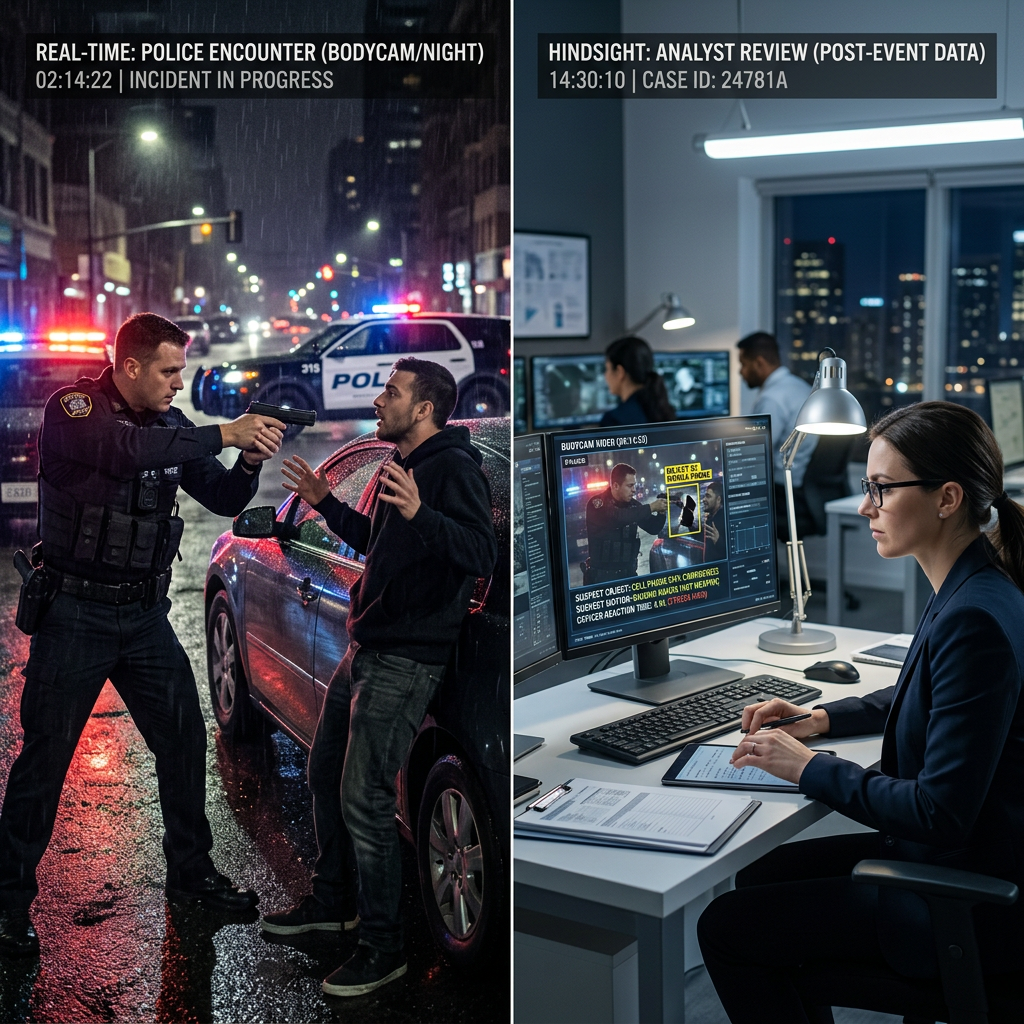
The goal is not self blame. The goal is self mapping. You are building an accurate chart of how your mind behaves under stress. Once you have a pattern identified you can design specific training to address it. This works exceptionally well when you review your body camera video of the situation and it directly contradicts with your preconceptions.
If you tend to ignore new information you can practice decision games in which scenarios are deliberately updated halfway through and you are required to state how you would adjust your plan. Research on cognitive training for police decision making shows that such structured exercises improve willingness to revise judgments and reduce unnecessary use of force, discretionary arrests, and injuries.
If you notice that you escalate when provoked you can use training environments where role players provide controlled verbal aggression while you practice remaining measured and task focused. Stress inoculation studies indicate that repeated controlled exposure combined with coping strategies increases resilience to emotional triggers and improves performance under pressure.
If you identify a tendency toward tunnel vision you can integrate visual scanning drills and callout requirements into scenarios so that you must identify new elements while managing the scenario. Perceptual cognitive training studies suggest that these drills enhance tracking of multiple relevant cues in complex visual scenes and improve situational awareness.
Over time the pattern is consistent. Your meta cognitive debrief informs your training plan. Your training plan shapes your meta cognitive performance on future calls. The loop reinforces itself.
Training Meta Cognition Practical Self Drills
Meta cognition becomes practical when broken into small repeatable drills that can be layered onto existing training and daily work. These drills do not require specialized equipment. They require deliberate intent.
Before each range session, BJJ class block, scenario, or even a normal shift you can set a meta cognitive objective. You might choose on this rep I will notice my stress before it spikes or on this scenario I will consciously generate at least one alternative explanation for what I am seeing. Goal setting research shows that specific process focused goals improve learning more than vague performance goals. Applying that logic to your thinking focuses your practice.
During training you can build in micro checks. On the range an instructor can call out a cue at a random moment requiring shooters to briefly shift their attention, scan, and identify a simple detail in the environment before continuing. In force-on-force training an instructor can call check prompting you to state what you are focused on and what you might be missing. These methods are consistent with findings from perceptual training and decision games where forced articulation of attention and reasoning enhances subsequent performance.
After training or after a call you can use a consistent three question debrief.
- Ask what did I think was happening at the start and how did that change?
- Where did stress or emotion affect my choices?
- What is one concrete mental adjustment I will deliberately make next time?
Repetition of this structure trains your mind to expect reflection and to link experience with future behavior. For field training officers and supervisors the same structure can be applied in coaching boots. The emphasis is on drawing out the new officer’s own description of their thinking rather than only telling them what they should have done. Educational research on metacognitive instruction shows that guiding learners to explain their reasoning improves transfer of skills to new situations more effectively than feedback on outcomes alone.
Meta Cognition for Regular Citizens
Meta cognition is not only for law enforcement. The same mechanisms apply to regular citizens in everyday life. People constantly make decisions under uncertainty, experience stress, and interpret ambiguous behavior. Meta cognitive skills can improve judgment, emotional control, and learning in these contexts as well.
In driving meta cognition can sit above basic situational awareness of traffic and road conditions. A driver who asks what am I focused on and what am I missing can catch themselves staring at the car directly ahead while failing to notice a merging vehicle or changing conditions further down the road. Studies on hazard perception training for drivers show that prompting people to verbalize what they expect to see and to scan more widely leads to better detection of hazards and fewer crashes. This is a meta cognitive layer added to normal visual awareness.
In work and study meta cognition helps people choose better strategies and avoid unproductive habits. A student who regularly asks do I actually understand this or am I just recognizing words and what will I do differently next time if this method does not work is more likely to adopt effective techniques such as self testing and spaced practice. Research on metacognitive strategy training in education shows improvements in comprehension, problem solving, and long term retention when learners are taught to monitor and regulate their own thinking.
In conflict and relationships meta cognition helps citizens avoid escalation and misunderstandings. In a heated argument someone who can notice I am getting defensive, my heart rate is up, I am interpreting everything as an attack and then choose to slow their speech and ask clarifying questions is using meta cognitive regulation of emotion and interpretation. Psychological studies link such skills to better conflict resolution, lower aggression, and improved relationship satisfaction.
In personal safety and threat assessment non law enforcement citizens can apply the same three phase structure. Before entering a situation they can ask what do I think this environment is like, what concerns do I have, and what is my plan if something feels wrong. During an encounter they can use micro checks such as what is drawing my attention, what am I ignoring, and how is my fear or anger coloring my interpretation. Afterward they can debrief what they noticed, what they missed, and what they would do differently next time. While civilians are not expected to perform like trained officers, the same basic meta cognitive loop improves awareness, reduces impulsive reactions, and supports more deliberate choices under stress.
For ordinary people dealing with anxiety and stress, meta cognition is central to many evidence based therapies. Approaches such as cognitive behavioral therapy teach individuals to notice automatic thoughts, question their accuracy, and replace them with more realistic interpretations. This is a structured form of meta cognition applied to internal experiences rather than external threats. Research shows that such meta cognitive skills reduce symptoms of anxiety and depression and increase resilience to future stressors.
The core idea is the same across these domains. Situational awareness notices what is happening. Meta cognition notices how you are thinking about what is happening and gives you tools to adjust that thinking. Whether you are an officer on a call, a citizen in traffic, a student in class, or a person under stress at home, training meta cognition extends your control over your own responses.
Why Meta Cognition Multiplies the Value of Other Training
Modern police training already includes elements that support better situational awareness. Scenario based training, stress inoculation drills, decision making courses, and perceptual cognitive programs all show measurable benefits in improving performance under stress, reducing critical errors, and supporting safer decisions for officers and the public.
Meta cognition functions as a force multiplier on top of these gains. It helps you notice when you are not using the skills you have been taught. It turns every call whether routine or critical into usable feedback about your mental patterns. It increases the likelihood that lessons from academy and in service training will appear in your behavior under pressure because you are actively connecting training to what your mind actually did on the street.
Without meta cognition strong technical and tactical skills can remain unused while old habits and automatic reactions dominate when stress is high. With meta cognition you increase the odds that you will bring your best thinking to your worst day.
Meta cognition does not replace situational awareness. It sits above it guiding it, correcting it, and sharpening it through deliberate self training. Over time training your awareness of your own thinking changes how you see, how you decide, and how you act whether you wear a badge or not.


Leave a Reply