Executive Summary
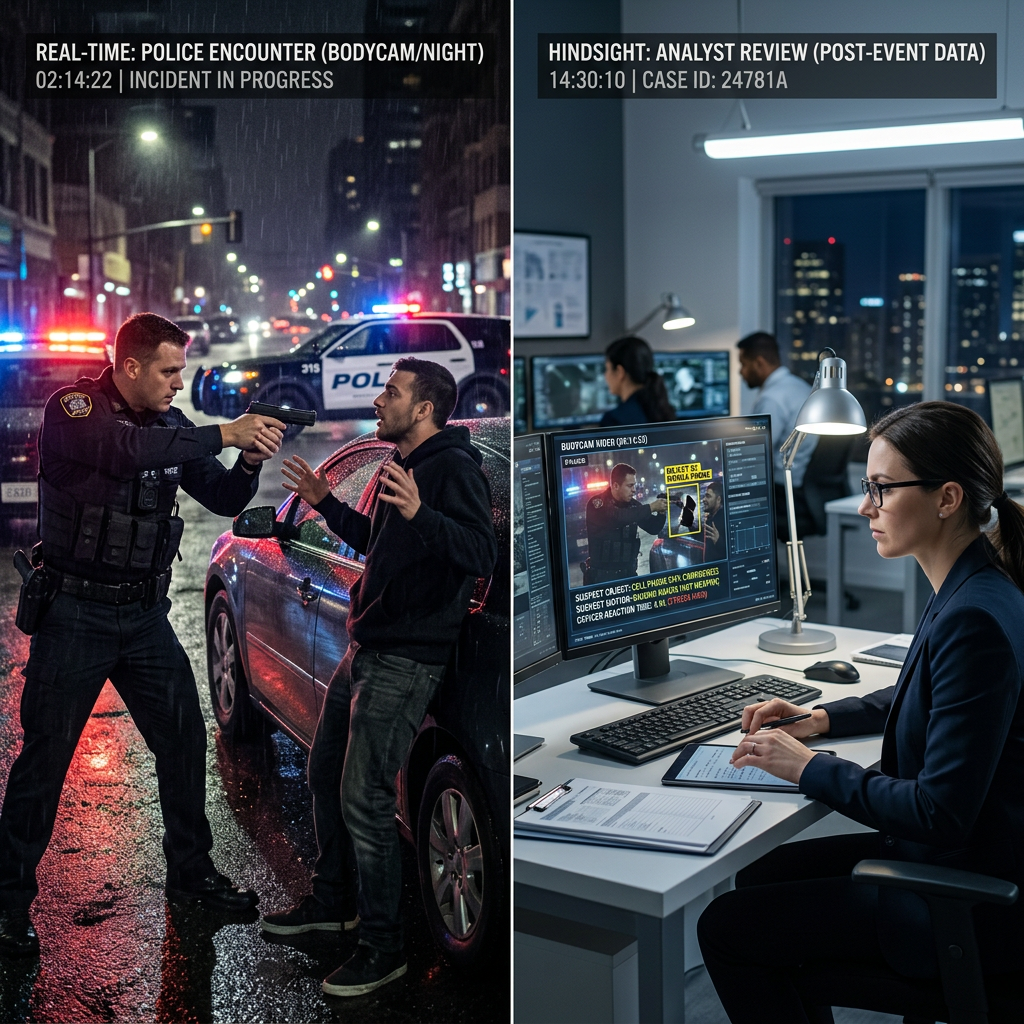
This post introduces and analyzes an informal fallacy in evaluative reasoning that is known as the Monday Morning Quarterback. (MMQB) The fallacy describes a recurring pattern in which observers judge high-stakes decisions made under uncertainty by substituting later knowledge and later clarity for the limited perspective of the original decision maker. Drawing on psychological research on hindsight bias and philosophical work on responsibility and moral luck, the post explains how this error distorts judgments of police officer-involved shootings and other lethal-force encounters (Roese & Vohs, 2012; Nagel, 1979).
The analysis proceeds in four steps. It first defines the fallacy and lays out its logical structure. It then examines its psychological and philosophical foundations with particular attention to hindsight bias and normative standards of foreseeability. Next, it applies the framework to officer-involved shootings, incorporating legal doctrine as one domain where the fallacy is especially consequential. Finally, it presents case studies and outlines implications for training, public discourse, and future research (Alpert et al., 2012; Graham v. Connor, 1989).
“The illusion that we understand the past fosters overconfidence in our ability to predict the future.” -Daniel Kahneman
Introduction
An informal fallacy that appears in public analysis of officer involved shootings and deadly force events. The fallacy arises when a later observer treats a completed incident as though its decisive facts were plain to the officer in the instant of that high stress incident. That mode of judgment conflicts with the legal requirement that force be assessed from the standpoint of the officer on scene rather than from a later and more privileged viewpoint (Graham v. Connor, 1989).
The phrase Monday Morning Quarterback is useful because it captures a stable defect in practical reasoning. The observer knows the ending. The observer then imports that ending into the moment of action. A legal inquiry is thereby transformed into a reconstructed narrative in which uncertainty is erased and necessity is understated (Graham v. Connor, 1989; Firearms Research Center, 2026).
Officer involved shootings create the ideal conditions for this error. The event is brief. The danger can be often ambiguous. The body is under high stress and the field of perception narrows under threat. Later review presents video and forensics. It also presents witness accounts and expert framing. That later record can become so cognitively dominant that the original decision point is no longer understood on its own terms (Firearms Research Center, 2026).
Definition
The Monday Morning Quarterback is an informal fallacy of retrospective evaluation in which a critic judges an officer’s use of deadly force by relying on information consolidated after the event. The critic then treats that later information as proof that the officer should have recognized the same central principles before firing (Graham v. Connor, 1989; Firearms Research Center, 2026).
The decisive flaw lies in the substitution of perspectives. The officer acts within a narrow temporal window. The critic reasons from a completed record. The officer confronts movement and uncertainty. The critic confronts sequence and closure. Once those standpoints are confused the analysis becomes unstable at its foundation (Rachlinski et al., 2016).
This is an informal fallacy because the defect is not merely symbolic. It is interpretive and evaluative. It corrupts judgment by altering the frame through which reasonableness is measured. It also generates moral certainty where the primary data remain contested or incomplete (Scribbr, 2023; Christensen, 2016).
Logical Form
The structure of the fallacy can be stated with precision.
A shooting has occurred. The result is now known (Graham v. Connor, 1989).
The observer possesses facts that were unavailable or unclear at the time of decision. These facts may include enhanced video and later witness testimony, as well as forensics (Firearms Research Center, 2026).
An alternative tactic can now be described. It may involve retreat or delay (Firearms Research Center, 2026).
The observer then concludes that the officer’s actual decision was plainly unreasonable when made. That conclusion does not follow from the prior premises because a later described option is not identical to a real time available option (Rachlinski et al., 2016).
The argument therefore commits a perspective error. It mistakes epistemic surplus for original awareness. It mistakes analytical reconstruction for human perception under high stress threat. It also mistakes conceivable alternatives for legally required alternatives (Graham v. Connor, 1989; Firearms Research Center, 2026).
Psychological Basis
The mind does not revisit danger in a neutral way. Once an ending is known perception reorganizes memory around the final result. Ambiguous cues begin to look ordered. Small movements begin to look legible. The event acquires a false clarity that was not available in real time (Scribbr, 2023; The Decision Lab, 2021).
This distortion has several layers. One layer concerns perceived predictability. Another concerns perceived inevitability. A third concerns memory revision in which the observer experiences the past as though the essential signs were always visible (Wikipedia, 2026; BMT, 2024).
In officer involved shootings that process is especially dangerous because the disputed issue is often a matter of seconds. A hand movement may be abrupt. A turn of the torso may suggest access to a weapon. Distance may be closing. Commands may be ignored. After the event a slowed image can make the same motion appear decipherable in a way that it was not during the encounter (Firearms Research Center, 2026).
Philosophical and Psychological Foundations
The Monday Morning Quarterback fallacy rests on the well documented phenomenon of hindsight bias. Hindsight bias is the tendency to see an outcome as more predictable and more obvious once it is known than it genuinely was before it occurred (Roese & Vohs, 2012; The Decision Lab, 2021).
Philosophically this creates a distortion in judgments of responsibility. Moral evaluation depends on what an officer could reasonably foresee and control at the time of action. Hindsight bias warps that evaluation by smuggling later certainty back into the earlier moment and by treating reconstructed clarity as if it had been available all along (Hedden, 2022; Pezzo, 2003).
From a psychological standpoint the bias operates through several interacting components. Researchers distinguish memory distortion in which past judgments are misremembered as closer to the outcome. They also distinguish perceived inevitability in which the world appears as though the result had to occur. A further element is foreseeability in which the observer feels that the outcome was personally knowable all along (Wikipedia, 2026; Roese & Vohs, 2012).
In officer involved shootings these components converge in a particularly charged way. The observer sometimes experiences a strong sense that the shooting was avoidable and also experiences a strong belief that the signs of danger or safety were legible for any competent officer. This combination easily generates moral condemnation that outruns the actual epistemic position of the actor at the scene (Scribbr, 2023; Pezzo, 2003).
There is also a motivational dimension. Humans do not merely record events. They seek to make sense of them in a manner that preserves a feeling of coherence and control. Explanations that portray negative outcomes as both predictable and preventable can paradoxically feel more reassuring because they imply that similar harms can be avoided next time through better vigilance or virtue (Pezzo, 2003; Menec & Weiner, 2000).
That drive toward sense making can pull evaluation away from fairness. When a community confronts a controversial police shooting there is a strong incentive to locate clear errors. The narrative that someone should have known better satisfies the demand for causal closure yet it may depend on hindsight bias rather than on a careful reconstruction of what information was truly available in the critical seconds (Roese & Vohs, 2012; Perspective-Taking and Hindsight Bias, 2022).
This has implications for how we think about blame and for how we design institutions. If hindsight bias systematically inflates judgments of what officers and agencies should have foreseen then public discourse will oscillate between outrage and disillusionment without accurately tracking the space of genuine negligence or misconduct. Philosophical work on moral luck already shows how outcomes beyond an officer’s control can heavily influence our blame attributions and hindsight bias amplifies this tendency in the domain of lethal force encounters (Hedden, 2022; Pezzo, 2003).
Recognizing the bias does not require moral neutrality about police shootings, or use of force more broadly. It instead demands a more disciplined form of criticism. The task is to hold officers and institutions accountable for what they could reasonably know and do while resisting the urge to convert every tragic outcome into proof of prior obviousness. Properly understood this discipline strengthens rather than weakens legitimate calls for reform because it grounds them in an accurate model of human perception and decision making under high stress threat (Roese & Vohs, 2012; The Decision Lab, 2021).
“The methodological inquiry leads to an account of how justice constrains the police through both special moral requirements that officers assume voluntarily, as well as general moral requirements in virtue of a polity’s commitment to moral, political and legal values beyond law enforcement and crime reduction.”
Hindsight Fallacy contrasted against MMBQ
Hindsight bias and the Monday Morning Quarterback fallacy share a common root but differ in scope and structure. Hindsight bias is a general psychological tendency: once an outcome is known, observers experience that outcome as more predictable and more inevitable than it actually was ex ante, and they quietly revise their sense of what could reasonably have been foreseen. The Monday Morning Quarterback fallacy is a narrower error in evaluative reasoning that builds on this tendency in a specific legal and moral context. It arises when a critic of a police shooting does not merely feel that the result was predictable, but actively substitutes the completed evidentiary record for the officer’s constrained, high‑stress point of view and then condemns the decision as unreasonable on the strength of options that existed only in reconstruction, not in real time. Hindsight bias is the background distortion, where the Monday Morning Quarterback is the structured way that distortion is turned into a faulty argument about what the officer should have done.
Legal Implications of the Fallacy
Use of force laws already recognizes the central problem. In Graham v. Connor the Supreme Court held that excessive force claims are governed by the Fourth Amendment standard of objective reasonableness. The Court stated that reasonableness must be judged from the perspective of a reasonable officer on the scene. The Court also warned against the use of perfect 20/20 review after the fact (Graham v. Connor, 1989; Oyez, 1989).
That language is not incidental. It identifies the jurisprudential hazard at the center of police shooting review. Courts must assess what the officer reasonably confronted. They must not collapse the constitutional inquiry into a later moral narrative assembled from superior information (Graham v. Connor, 1989; NYU Review of Law and Social Change, 2024).
Tennessee v. Garner also bears on the issue because it limits deadly force against fleeing suspects absent a sufficient threat basis. Yet Garner does not abolish the need to evaluate the event through the officer’s situational perspective. It instead requires careful inquiry into threat and necessity. That inquiry becomes corrupted when later facts are treated as though they were immediate facts (Firearms Research Center, 2026; Police1, 2019).
Case Law Problems
The legal problem is not confined to doctrine in the abstract. It appears in the practical administration of excessive force litigation and criminal review. Courts and juries must decide what could reasonably be perceived at the moment force was used. Yet they do so after prolonged exposure to evidence that no participant possessed in the same form at the scene (Rachlinski et al., 2016; Conklin, 2022).
One recurring problem involves unarmed subjects who are believed to be armed. In such cases judges must decide whether the mistaken perception of danger was still objectively reasonable under the circumstances. The later discovery that no gun existed can powerfully shape moral reaction. It does not itself resolve the constitutional issue because the legal test does not ask what was eventually found. It asks what a reasonable officer could perceive in the moment (Graham v. Connor, 1989; Columbia Law Review, 2016).
“Objectively reasonable” force is force that a reasonable officer, with the same training and in the same circumstances, could have believed necessary at the time, judged from the perspective of a reasonable officer on the scene and not with the 20/20 vision of hindsight.
Another problem concerns what some scholars and advocates describe as officer created jeopardy. Under that theory an officer may act imprudently before the final instant and thereby help create the danger that culminates in the shooting. That issue is legally serious. It can expose weak tactics and poor planning. Yet the doctrine also risks importing a later omniscient review into a fluid encounter unless courts distinguish antecedent negligence from immediate threat perception with unusual care (Force Science, 2024; NYU Review of Law and Social Change, 2024).
A further difficulty arises in jury comprehension. Jurors often carry intuitive standards that differ from constitutional standards. They may assume that any visible alternative proves legal unreasonableness. They may also infer that a bad outcome establishes a bad decision. Scholarship on adjudication and jury instruction has warned that this kind of retrospective distortion can affect legal findings unless the evaluative frame is tightly controlled (Conklin, 2022; Rachlinski et al., 2016).
Practical Manifestations in Officer Involved Shootings
The fallacy appears in familiar public claims. A suspect turned out to be unarmed. Therefore there was no real threat. A video reveals a narrow opening for retreat. Therefore retreat was plainly required. A less lethal option can be named. Therefore deadly force was clearly forbidden. Each claim compresses a dynamic event into a static diagram (Firearms Research Center, 2026).
That compression produces analytical overreach. The legal question is not whether a calmer observer can imagine another path. The legal question is whether the officer’s perception and response were objectively reasonable under rapidly evolving conditions. Once that distinction is lost the debate becomes performative rather than forensic (Graham v. Connor, 1989; Police1, 2019).
This does not excuse unlawful shootings. It does not immunize departments from criticism. It instead imposes discipline on criticism. A serious critique must show why the officer’s action was unreasonable from the informational horizon present at the scene. It must also distinguish tactical failure before the final instant from constitutional unreasonableness at the instant force was used (Texas Law Review, 2020; Northwestern Law Review, 2019).
Illustrative Officer-Involved Shootings and Media Narratives
Several high-profile shootings demonstrate how early media narratives invited a Monday Morning Quarterback reaction that later evidence complicated or undercut. These cases show how hindsight bias can make force decisions look obviously wrongful before a complete record exists (Alpert et al., 2012; Roese & Vohs, 2012).
Tamir Rice, Cleveland (2014)
Initial coverage of the Tamir Rice shooting quickly crystallized around a simple picture. Commentators emphasized that Tamir Rice was twelve years old and that the gun was a toy and many then asserted that any reasonable officer should have seen that he was a child and should have recognized that the gun was fake before firing (Vox, 2014; Killing of Tamir Rice, 2026).
Later factual development showed a more complex perceptual situation. The 911 caller told the dispatcher that the gun was “probably fake” and that the suspect was “probably a juvenile” yet the dispatcher failed to relay those crucial qualifiers to responding officers (U.S. Department of Justice, 2020; Killing of Tamir Rice, 2026). From the officers’ perspective the radio run indicated a male with a gun in a public park with no information that it might be a toy. Enhanced video stills reviewed by federal investigators showed a dark object consistent with a handgun at Tamir Rice’s waist and then on the ground within seconds in a time frame measured in moments rather than in reflective minutes (U.S. Department of Justice, 2020).
Federal prosecutors ultimately closed the civil rights investigation and explained that the available evidence could not prove beyond a reasonable doubt that the officer acted with the deliberate criminal intent required for federal charges (U.S. Department of Justice, 2020). Independent experts retained by local prosecutors had already concluded that the rapid approach and shooting, though deeply troubling tactically, could be viewed as objectively reasonable under governing doctrine once the officers’ limited information set was taken into account (Alpert et al., 2012; Reddit, 2015). The strong early media claim that the situation was plainly harmless, and that any competent officer should have seen that instantly, reflects a classic hindsight error in which observers treat knowledge of the toy, the age, and the final outcome as if it had been available to the officers in real time.
Cleveland Heroic Rescue Body-Cam Case (2015)
In another Cleveland incident a body-worn camera captured an officer running directly toward an armed suspect who had just shot another officer and then rendering aid under extreme threat (Washington Post, 2015). Initial social media commentary on short clips suggested recklessness and unnecessary risk-taking and critics argued that a reasonable officer would have maintained cover and waited for backup, asserting that the conduct endangered everyone on scene (Washington Post, 2015).
A more detailed review of the body camera video and radio traffic produced a different assessment. The footage showed that the suspect had already been shot and disarmed and that the surviving officer was moving rapidly to stop further harm and to treat a downed colleague (Washington Post, 2015). Use-of-force analysts noted that the same aggressive movement that appeared reckless in a de-contextualized clip was tactically justified once the precise timing of shots, the suspect’s condition, and the need for immediate medical intervention were understood (Alpert et al., 2012; Washington Post, 2015). The initial condemnations implicitly assumed facts about the suspect’s capacity to continue firing that were false and assumed that the officer knew he was still under active lethal threat when the threat profile had already shifted.
Here the Monday Morning Quarterback fallacy operated in visual form. The public saw a distilled moment and filled in missing details with worst-case assumptions and later information showed that the factual premises behind the criticism were incorrect. Industry pundits had projected their own reconstructed sense of danger into the officer’s mind and then judged him against that reconstruction rather than against his actual situation on scene (Alpert et al., 2012).
Samuel DuBose, Cincinnati (2015), as a Contrast Case
Some high-profile shootings reveal the opposite pattern and help clarify what the Monday Morning Quarterback fallacy is not. In the Samuel DuBose case a University of Cincinnati officer shot an unarmed motorist during a traffic stop and later claimed that he had been dragged by the vehicle and forced to fire (Meares, 2017). Body-camera video showed that this account was false and that no dragging occurred and the shooting followed a rapid escalation in which the officer initiated deadly force as the car began to roll (Meares, 2017).
Here the early official narrative portrayed the shooting as a straightforward instance of self-defense and much of the first reporting repeated that framing. The later visual record undercut the officer’s justification and led to an indictment. This case is important because it illustrates that post-hoc video and forensic analysis do not always create a bias in favor of the officer. Sometimes they correct an initial narrative that hid or justified misconduct. The Monday Morning Quarterback fallacy does not consist in any use of retrospective evidence; it consists in the uncritical assumption that whatever seems clear after full reconstruction must have been equally clear to the officer in the split second in which the decision was made (Alpert et al., 2012; Graham v. Connor, 1989).
Lessons from These Cases
The Tamir Rice and Cleveland rescue incidents show how information consumers can reason from later knowledge and later clarity and then attribute that clarity to officers who did not share the same informational vantage point. In Tamir Rice the public knew that the gun was plastic and that the subject was twelve years old. In the rescue case the public knew that the suspect was already incapacitated. Those facts dominated moral reaction and observers treated those facts as if they were obvious and available to the officers and concluded that the officers’ choices were plainly unreasonable (U.S. Department of Justice, 2020; Washington Post, 2015).
The law does not permit that shortcut. Graham v. Connor requires that force be assessed from the perspective of a reasonable officer on the scene in light of the facts and circumstances confronting the officer without the distortions of twenty-twenty hindsight (Graham v. Connor, 1989). The Monday Morning Quarterback fallacy arises when commentators bypass that legal standard and hold officers to the standard of what is only visible after replay, investigation, and commentary have done their work. It is not the presence of criticism that marks the fallacy; it is the method by which the criticism is generated (Alpert et al., 2012).
These examples also show why careful investigation and transparent release of evidence are essential. The same body-cam video that can fuel a premature narrative when excerpted can correct that narrative when studied in context. Work on officer-involved shooting investigations emphasizes the need for structured reconstructions that distinguish the officer’s information set from the community’s later information set (Alpert et al., 2012; Terrill, 2021). Properly handled, retrospective evidence can mitigate the Monday Morning Quarterback fallacy rather than amplify it.
Social Media Influencers and the MMBQ Fallacy
A particular complication arises when social media influencers in the 2A training industry adopt the Monday Morning Quarterback posture as a branding strategy. These commentators often present slowed, annotated footage of officer-involved shootings and then deliver confident verdicts about what a “switched-on” or “properly trained” shooter would have done instead, as though their post‑hoc refinements were plainly available in the officer’s actual moment of high stress peril. In doing so they do not merely suffer from hindsight bias in a private way. They package hindsight as expertise, export it to large audiences, and invite followers to measure real-world officers against stylized range scenarios, controlled drills, or curated self‑defense anecdotes that bear little resemblance to the perceptual chaos of an actual deadly force encounter.
That practice is not value‑neutral. It is morally and professionally defective because it trades on a systematic substitution of perspectives while purporting to teach judgment. The influencer occupies a position of conclusion knowledge, in that they know the outcome, they have the full investigative record or an edited approximation of it, and they enjoy unlimited time to freeze frames, replay angles, and script “better” options. The officer, by contrast, confronted a compressed time horizon, ambiguous cues, and the physiological narrowing of attention under threat. When the influencer blurs that difference and speaks as though their reconstructed clarity had been, or should have been, available in real time, they commit the core error this post identifies as the Monday Morning Quarterback fallacy.
There is also an ethical dimension that goes beyond analytical sloppiness. Many 2A‑oriented trainers market themselves as guardians of “real‑world” competence and responsibility with firearms. Yet when they publicly dissect police shootings through the lens of post‑incident omniscience, they model precisely the kind of ungrounded overconfidence that responsible gun handling is supposed to resist. They encourage civilian students to believe that lethal encounters can be managed with cinematic precision and that any deviation from that imagined standard proves cowardice, incompetence, or bad faith. In doing so they not only misinform their audience about the realities of human perception and reaction time, they also erode the public’s ability to distinguish genuinely unreasonable force from tragic but legally and knowledge constrained action. That erosion is ethically troubling because it weaponizes a known cognitive distortion like hindsight bias, for attention, clicks, and brand differentiation rather than for careful inquiry into how deadly force decisions are actually made.
Officer Knowledge and the Internal Scene
Deadly force events do not occur against a blank cognitive background. The officer who arrives at a volatile scene brings a particular body, a particular mind, and a particular day. The length of the shift, hours awake, and basic factors like food and hydration quietly shape attention, reaction time, and working memory. An officer on the tenth hour of a night tour, running on energy drinks and a protein bar, does not inhabit the same perceptual world as an officer at the start of a well‑rested day. The information on paper may match; the capacity to register, prioritize, and use it does not.
The officer’s mental status matters in equally concrete ways. A person who has just cleared a horrific fatal‑accident scene, or is still carrying stress from an earlier domestic violence call, will process threat cues differently from someone whose prior hours have been uneventful. Intrusive images, residual adrenaline, or emotional exhaustion can narrow the field of view or heighten sensitivity to some movements while dulling sensitivity to others. Plans to seek counseling after shift, or a background of depressed mood, never appear in the CAD record, yet they influence how incoming stimuli are filtered and how quickly an ambiguous gesture becomes perceived lethal danger. Experience adds another layer: a brand‑new officer does not have the same resilience or practical judgment as a seasoned veteran who has worked through similar crises before.
Training sits at the intersection of these internal and external factors. Officers are drilled on patterns: the “type” of call, likely weapons, and the statistical chance of escalation. But training is not a script that simply runs on command. It is a collection of habits and expectations that can steady a tired mind or, under enough fatigue and stress, misfire in unpredictable ways. An officer may know the doctrinal answer to a scenario in the classroom and still find that, at midnight in a cramped hallway with bad lighting, their practical grasp of that answer is partial and fragile. Their real‑time understanding of what training requires is itself a fact about the scene, not an abstract constant floating above it.
The Monday Morning Quarterback fallacy becomes especially severe when critics ignore this interior scene. Later commentators often assume that the officer’s “knowledge” consisted only of the radio run and the visible environment. They leave out how long the officer had been awake, whether they had eaten, whether their hands were still shaking from a prior fight, or whether the last call involved a near miss that is still echoing in their nervous system. They also treat training as if it were a hard‑wired program that should execute flawlessly, rather than a skill set that degrades under fatigue, hunger, and cumulative trauma.
A disciplined analysis of deadly force must therefore ask not only what information was theoretically available, but what information could realistically be taken in and used by this officer, in this body, on this shift. It must distinguish the clean lines of a post‑incident diagram from the smudged, partial grasp available in the moment. Once those distinctions are flattened, the evaluation of reasonableness slides quietly from a judgment about human perception under high stress into a judgment about how a rested, well‑fed, emotionally neutral ideal observer would have performed. That slide is not merely a technical mistake. It is a moral mistake, because it erases the lived conditions under which real officers make the choices we later sit in comfort to dissect.
The Monday Morning Quarterback fallacy enters at precisely this point. It encourages critics to set aside fatigue, nutrition, prior calls, and cumulative stress because those realities are messy, hard to quantify, and invisible on a replayed video. It is far easier to treat the officer as a generic rational actor with perfect access to all visible facts and then reason: a better option can now be named, therefore that option must have been obvious, therefore the failure to select it proves unreasonableness. In this way a complex, embodied decision made under constraint is quietly converted into a simple logic exercise whose premises are supplied by hindsight rather than by the officer’s actual situation.
Formal Statement of the Fallacy
Name
The Monday Morning Quarterback.
Type
An informal fallacy of retrospective legal and moral evaluation in police shooting analysis (Graham v. Connor, 1989; Rachlinski et al., 2016).
Definition
A fallacy in which a reviewer of an officer involved shooting imports later acquired information into the instant of danger and then treats that imported knowledge as proof that the officer should have perceived the same reality before using deadly force (Graham v. Connor, 1989; Firearms Research Center, 2026).
General Pattern
The event is over. The ending is known (Graham v. Connor, 1989).
The record is enlarged by investigation and replay. The original perspective is now displaced (Firearms Research Center, 2026).
A better option is described after reflection. That option is treated as though it was plainly available in real time (Rachlinski et al., 2016).
The officer is therefore said to have acted unreasonably. The inference exceeds the evidence because temporal knowledge and practical availability are not the same thing (Columbia Law Review, 2016).
Error
The fallacy substitutes a completed evidentiary record for an unfolding threat environment. It thereby converts retrospective intelligibility into supposed contemporaneous certainty (Graham v. Connor, 1989; The Decision Lab, 2021).
Corrective Rule
Deadly force analysis must begin with scene based reasonableness. It must then ask what facts were available to the officer. It must finally determine whether the force decision was lawful under those facts rather than under a later and richer archive (Graham v. Connor, 1989; Oyez, 1989).
Conclusion
The Monday Morning Quarterback names a real defect in reasoning about officer involved shootings. It identifies the tendency to judge action in mortal uncertainty through the lens of later order and later knowledge. That defect is psychologically potent. It is also legally corrosive because it distorts the constitutional measure of reasonableness (Graham v. Connor, 1989; Rachlinski et al., 2016).
A rigorous analysis of police shootings must preserve temporal integrity. It must separate the officer’s decisional world from the investigator’s reconstructed world. Only then can criticism become exact. Only then can legal review remain fair. Only then can reform proceed without sacrificing analytical truth (NYU Review of Law and Social Change, 2024; Conklin, 2022).
Implications
The Monday Morning Quarterback fallacy has direct implications for psychology, philosophy, and institutional design. For psychologists it highlights the need to study hindsight bias not only as an individual judgment error but also as a socially embedded pattern that shapes public reaction to rare and emotionally charged events such as officer-involved shootings (Roese & Vohs, 2012; Pezzo, 2003). For philosophers it raises questions about how moral responsibility should be assigned when observers cannot easily separate outcome knowledge from ex ante epistemic position, and it connects directly to debates about moral luck and the role of outcome in blame (Nagel, 1979; Outcome effects, moral luck, and the hindsight bias, 2023).
For legal and policy institutions the fallacy suggests that procedures must be designed to counteract predictable distortions in post-incident evaluation. This includes careful jury instructions that explain why the constitutional standard focuses on the perspective of a reasonable officer at the scene, and it includes investigative protocols that explicitly distinguish what was known or reasonably knowable at the time from what emerged only through later inquiry (Graham v. Connor, 1989; Conklin, 2022). Training for investigators, prosecutors, and oversight bodies can incorporate structured perspective-taking exercises that make the limitation of human perception under high stress more salient, thereby reducing the unexamined influence of hindsight bias (Alpert et al., 2012; Terrill, 2021).
References
BMT. (2024, August 28). Hindsight bias: Its effects on decision making and implications for project management. https://www.bmt.org/insights/hindsight-bias-its-effects-on-decision-making-and-implications-for-project-management/
Christensen, A. J. (2016, June 20). Hindsight evidence. Columbia Law Review. https://columbialawreview.org/content/hindsight-evidence/
Conklin, J. (2022). Jury instruction at mitigating hindsight bias. Baylor Law School. https://law.baylor.edu/sites/g/files/ecbvkj1546/files/2023-11/07%20Conklin.pdf
Firearms Research Center. (2026, February 22). Ten misunderstandings about police shootings. https://firearmsresearchcenter.org/forum/ten-misunderstandings-about-police-shootings/
Graham v. Connor, 490 U.S. 386 (1989). https://supreme.justia.com/cases/federal/us/490/386/
Northwestern Law Review. (2019, June 24). The futile Fourth Amendment: Understanding police excessive force doctrine through an empirical assessment of Graham v. Connor. https://northwesternlawreview.org/issues/the-futile-fourth-amendment-understanding-police-excessive-force-doctrine-through-an-em
NYU Review of Law and Social Change. (2024, March 1). Rethinking hindsight: The failed interpretation of Graham v. Connor. https://socialchangenyu.com/review/rethinking-hindsight-the-failed-interpretation-of-graham-v-connor/
Oyez. (1989). Graham v. Connor. https://www.oyez.org/cases/1988/87-6571
Police1. (2019, May 22). The influence of Graham v. Connor on police use of force. https://www.police1.com/officer-shootings/articles/graham-v-connor-three-decades-of-guidance-and-controversy-uqgh9iY6XPGTdHrG/
Rachlinski, J. J., Wistrich, A. J., & Guthrie, C. (2016, June 20). Hindsight evidence. Columbia Law Review. https://columbialawreview.org/content/hindsight-evidence/
Scribbr. (2023, February 9). What is hindsight bias? Definition and examples. https://www.scribbr.com/research-bias/hindsight-bias/
Texas Law Review. (2020, February 17). When an officer kills: Turning legal police conduct into illegal police misconduct. https://texaslawreview.org/when-an-officer-kills-turning-legal-police-conduct-into-illegal-police-misconduct/
The Decision Lab. (2021, October 10). Hindsight bias. https://thedecisionlab.com/biases/hindsight-bias
Wikipedia. (2026). Hindsight bias. https://en.wikipedia.org/wiki/Hindsight_bias


Leave a Reply