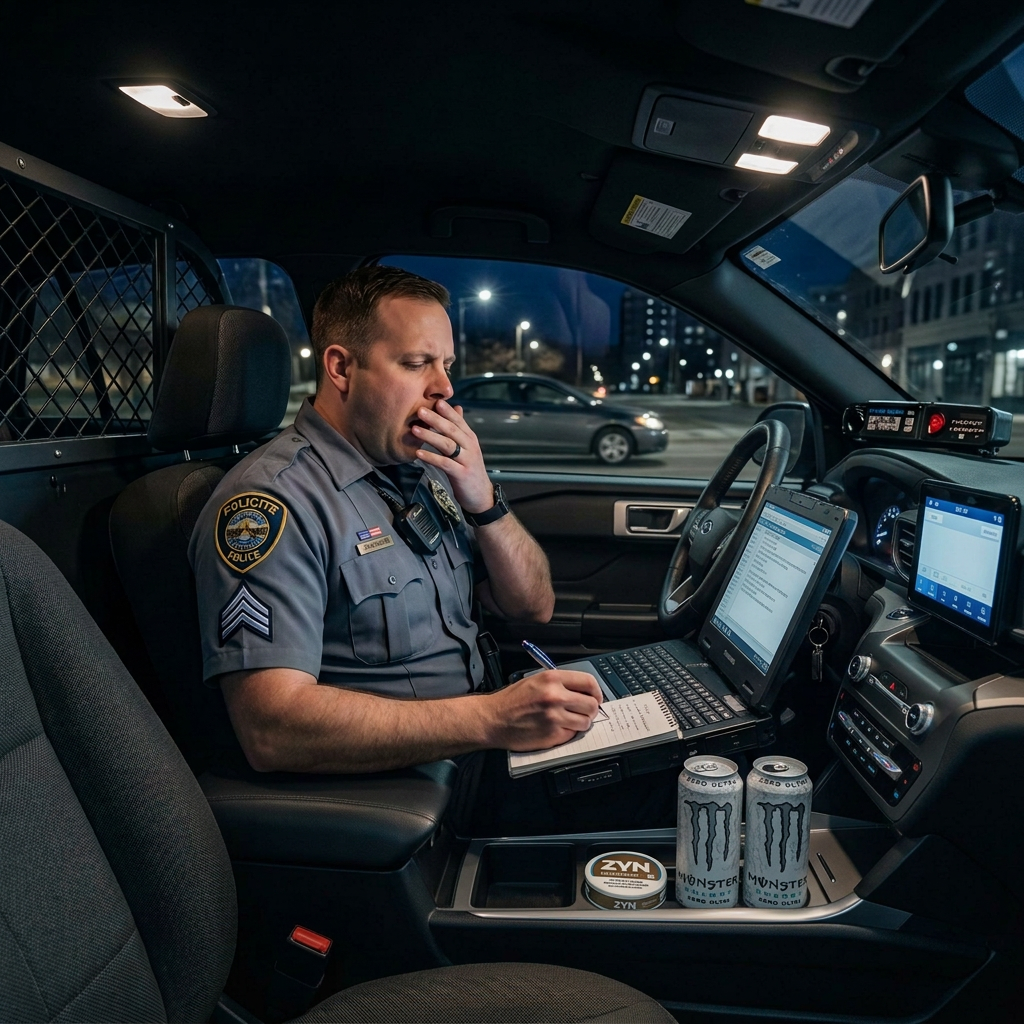
Low energy is a signal rather than a diagnosis
An officer can become accustomed to fatigue without becoming resistant to its effects.
In a study published in Sleep, researchers assessed 29 patrol officers after five consecutive 10.7-hour night shifts and after three consecutive days off. Tests were performed at the same morning time, and the order of conditions was randomized. After consecutive nights, officers showed worse simulated lane control, more vigilance lapses, and greater subjective sleepiness. Two officers crashed during the simulator session after night shifts, leaving incomplete driving records that were excluded from the primary driving analysis (Waggoner et al., 2012).[pmc.ncbi.nlm.nih]
This was a small study from one department. It does not establish a real-world crash rate, and it should not be cited as proof of impaired shooting decisions. Nevertheless, it demonstrates an operational concern. Familiarity with night work did not prevent measurable deterioration in attention and driving performance.
The evidence is directly about police officers, but the underlying recovery questions also matter to firefighters, emergency medical personnel, dispatchers, healthcare workers, and others working demanding schedules. Different occupations require their own research rather than an assumption that every police finding transfers unchanged.
Energy drinks provide stimulation rather than recovery
When energy falls, a convenient response is another can. The problem begins when the drink becomes a substitute for examining why alertness is failing.
The products themselves differ. A standard 16-ounce Monster Zero Ultra, commonly called white Monster, contains approximately 150 milligrams of caffeine and no sugar. A 16-ounce Ghost Energy contains 200 milligrams of caffeine and no sugar. An 8.4-ounce original Red Bull contains 80 milligrams of caffeine and 27 grams of sugar. Check the actual label because sizes and formulations vary (Monster Energy, n.d.; Red Bull, n.d.; Walmart, n.d.).[caffeineinformer][monsterenergy][walmart][redbull]
That comparison requires precision. The added sugar argument applies to original Red Bull, not to the compared white Monster and Ghost products. Sugar-free does not mean caffeine-free, however. Two standard Ghost cans supply 400 milligrams before counting coffee or other sources.
A 2024 study examined energy drink consumption and sleep among 53,266 Norwegian students aged 18 to 35. More frequent consumption was associated with shorter sleep, poorer sleep efficiency, and more insomnia symptoms. Daily consumers slept approximately 30 minutes less than people who rarely or never consumed energy drinks (Kaldenbach et al., 2024).[pmc.ncbi.nlm.nih][news-medical]
The study cannot establish causation. Poor sleepers may reach for energy drinks more often, energy drinks may contribute to poor sleep, or both may occur. It also does not identify a particular brand as responsible. Its value is in showing that frequent consumption and poor sleep commonly occurred together.
Sugar-free does not mean biologically inactive, and avoiding sucralose in a routine caffeine drink is a reasonable precaution, rather than a medically established requirement for everyone. In a randomized human trial, two weeks of sucralose consumption altered the gut microbiome and impaired glucose responses compared with controls, although individual responses varied (Suez et al., 2022). Another study found reduced insulin sensitivity when sucralose was consumed with maltodextrin, but not when sucralose was consumed alone, demonstrating that the conditions of consumption matter (Dalenberg et al., 2020). The evidence is mixed, with a separate trial finding no significant changes in gut microbiota composition after sucralose consumption (Ahmad et al., 2020). These findings do not establish that ordinary consumption causes diabetes, damages the brain, or crosses the human blood-brain barrier. For a first responder choosing a regular caffeine source, plain unsweetened coffee is a straightforward way to avoid sucralose without relying on those unsupported claims. Avoiding it can simplify the routine, but caffeine dose, timing, and adequate sleep remain separate concerns.
Nicotine Pouches Are Not a Recovery Strategy
Nicotine pouches offer a discreet way to consume a stimulant without smoking. That convenience should not be mistaken for a benefit to sleep or operational readiness. For a first responder already using caffeine to manage fatigue, adding nicotine introduces another exposure to consider rather than correcting the underlying need for recovery. Nicotine is addictive, and smokeless delivery does not remove its effects on the cardiovascular system (American Heart Association, 2025).[ahajournals]
The distinction is between stimulation and recovery. Research on nicotine and sleep describes disturbances associated with nicotine exposure as well as withdrawal. Much of that evidence comes from smoking and nicotine replacement products, not modern oral pouches. It therefore supports caution about nicotine use around sleep, but it does not justify claiming that one pouch reduces deep sleep by a specific percentage or that every pouch user develops insomnia (“Sleep as a Target for Optimized Response to Smoking Cessation,” 2019).[academic.oup]
Pouch-specific experiments nevertheless show that these products can deliver substantial nicotine. A 2024 crossover study tested nicotine-free pouches, pouches containing 6, 20, and 30 milligrams, and a cigarette in 15 regular smokers. Participants used the pouches for 20 minutes, and researchers measured nicotine exposure and cardiovascular responses over four hours. During use, heart rate rose by approximately 12 beats per minute with the 20 milligram pouch and 25 beats per minute with the 30 milligram pouch, compared with approximately 27 beats per minute after the cigarette. The 6 milligram pouch produced a smaller response. The 30 milligram pouch also produced greater nicotine exposure than the cigarette in that experiment (“Small Pouches, but High Nicotine Doses,” 2024).[pmc.ncbi.nlm.nih]
Those were high-strength products tested in a small group of established smokers. The findings should not be transferred unchanged to every lower strength pouch or used to declare that pouches carry the same overall risks as cigarettes. They do demonstrate that a small pouch can deliver a substantial drug dose. Product strength, absorption, and the number used deserve attention rather than treating each pouch as a minor addition to the shift.
Oral health is another concern. A 2024 systematic review found reports of mucosal changes at placement sites, soreness, dry mouth, and other local symptoms. The available studies were few and had substantial limitations, so they cannot establish the long-term risk of oral cancer or prove that every user will develop gum disease. Persistent irritation or a lesion where a pouch sits still warrants dental assessment rather than repeated placement over the affected area (Rungraungrayabkul et al., 2024).[link.springer]
There is an important distinction between starting nicotine and replacing smoking. For someone who does not use nicotine, pouches introduce dependence and potential adverse effects without an established role in treating fatigue or improving sleep. For an adult who smokes, completely replacing cigarettes with a product that avoids combustion may reduce exposure to harmful substances, but lower exposure does not mean harmlessness. The American Heart Association emphasizes that smokeless oral nicotine products remain addictive and may have adverse cardiovascular effects (American Heart Association, 2025).[ahajournals]
For the sleep journal, record nicotine alongside caffeine. Document the product strength, number of pouches, approximate duration of use, and time of the last pouch before intended sleep. This is a practical tracking method, not a validated pouch treatment protocol. If nicotine use changes while a supplement is being tested, that change becomes another possible explanation for improved or worsened sleep. Do not assume melatonin, theanine, or magnesium cancels nicotine’s effects.
Withdrawal also complicates interpretation. Insomnia is a recognized nicotine withdrawal symptom, so sleep can become temporarily more difficult during cessation. That difficulty should not be interpreted as proof that nicotine is necessary for good sleep. A clinician can help plan cessation and address symptoms without turning an unsupervised supplement stack into a substitute for treatment (“Sleep as a Target for Optimized Response to Smoking Cessation,” 2019).[academic.oup]
For first responders, the practical recommendation is not to start nicotine pouches as an alertness aid. Existing users should consider their nicotine exposure part of the recovery assessment and seek help with reducing or stopping use when appropriate. The goal is not to require one stimulant to work and another product to sleep. It is to protect sleep opportunity, evaluate persistent fatigue, and avoid adding dependence to an already demanding schedule.
Plain coffee is a better default with important limits
For someone choosing caffeine, a modest serving of plain black coffee is a sensible default over a conventional sugary energy drink. It avoids added sugar and does not require a blend of supplemental ingredients to deliver caffeine.
Think simplicity, not immunity.
The evidence does not establish that black coffee is vastly better than every sugar-free energy drink containing an equivalent caffeine dose. Nor does it establish that adding a little milk makes coffee unhealthy. The practical preference is narrower. Keep the caffeine strategy uncomplicated, avoid unnecessary added sugar, and account for dose and timing.
A randomized crossover trial in 18 healthy adults provides one reason not to assume energy drink mixtures behave identically to caffeine alone. Participants consumed either 32 ounces of an energy drink or a control containing the same 320 milligrams of caffeine. The energy drink condition produced a higher corrected QT interval at two hours and a greater systolic blood pressure elevation at six hours (Fletcher et al., 2017).[pubmed.ncbi.nlm.nih]
The corrected QT interval concerns the heart’s electrical recovery between beats. The approximately ten millisecond result was a difference between conditions, not a ten millisecond average rise from baseline in the energy drink group.
This was a high-volume experiment. The control was not coffee, and the findings do not prove that one can of any named product causes a dangerous heart rhythm. They support caution about treating a complete energy drink formulation as interchangeable with caffeine alone.
Coffee still has a cost when used carelessly. A systematic review found that caffeine generally prolonged sleep onset, reduced sleep duration and efficiency, and affected slow wave sleep (Clark & Landolt, 2017).[academia]
A later meta-analysis associated caffeine with approximately 45 minutes less total sleep, nine additional minutes to fall asleep, and twelve additional minutes awake after sleep onset. These are pooled research results, not a prediction that every drink costs exactly 45 minutes of recovery (Gardiner et al., 2023).[sciencedirect]
For a first responder planning to sleep shortly after duty, an additional late shift drink should therefore be considered part of the sleep problem, not only a solution to the current fatigue. NIOSH describes a typical caffeine half-life of approximately five to six hours, with substantial individual variation (National Institute for Occupational Safety and Health [NIOSH], n.d.).[cdc]
Simply put, you should not drink coffee, or intake caffeine, within 6 hours of scheduled bedtime.
Poor sleep and low energy require examination of the schedule
A first responder needs enough time to sleep, not merely an interval between assignments.
In the Buffalo police study, poor sleep quality affected approximately 44 percent of officers working days, 60 percent working afternoons, and 69 percent working nights. Researchers used electronic work histories to characterize schedules rather than depending solely on recalled shifts. The observational design cannot establish causation, but the pattern shows that the burden was substantial across schedules (Fekedulegn et al., 2016).[pmc.ncbi.nlm.nih]
A study of 3,140 police officers associated sleep under six hours with higher odds of overall burnout and emotional exhaustion. Excessive sleepiness was also associated with emotional exhaustion. Irregular schedules, mandatory overtime, and frequent shifts lasting at least 11 hours were relevant exposures (Peterson et al., 2019).[bmjopen.bmj]
These are associations, not proof that one schedule caused each outcome. They nevertheless undermine the idea that recovery is solely a matter of personal discipline.
A randomized experiment in Detroit and Arlington assigned officers to eight, ten, or twelve hour schedules. The ten hour group averaged approximately 7.86 hours of daily sleep, compared with 7.27 hours in the eight hour group. Officers on twelve hour schedules reported more sleepiness and lower alertness than those on eight hour schedules, although measured shooting and driving performance did not significantly differ (Amendola et al., 2011).[policinginstitute]
The experiment does not establish a universally optimal schedule. It demonstrates that schedule design can change recovery opportunities and that longer shifts cannot be judged only by the number of days off they produce.
Persistent tiredness may involve a sleep disorder
Not every exhausted first responder simply needs an earlier bedtime.
Among 4,957 officers screened in a major study, 40.4 percent screened positive for at least one sleep disorder. Approximately 33.6 percent screened positive for obstructive sleep apnea. Shift work disorder screening was positive in 14.5 percent of night shift officers (Rajaratnam et al., 2011).[jamanetwork]
Screening is not diagnosis. The finding still supports clinical evaluation rather than assuming persistent sleepiness can be corrected with melatonin or magnesium.
For chronic insomnia, cognitive behavioral therapy for insomnia has a strong recommendation from the American Academy of Sleep Medicine. It is a structured treatment, not simply advice to buy a different pillow or avoid a phone before bed (Edinger et al., 2021).[pmc.ncbi.nlm.nih]
Shift work sleep disorder involves persistent insomnia, excessive sleepiness, or both when work hours conflict with the usual biological sleep period. First responders diagnosed with this condition may be prescribed wakefulness-promoting medications such as modafinil, sold as Provigil, or armodafinil, sold as Nuvigil. These medications can reduce sleepiness, but they are not a cure for circadian disruption or a replacement for adequate sleep (Czeisler et al., 2005; Czeisler et al., 2009). In a three-month trial involving 209 patients, modafinil improved vigilance and reduced reported commuting accidents or near accidents, yet substantial residual sleepiness remained (Czeisler et al., 2005). Their use should therefore be deliberate and supervised, not a way to extend duty hours or override exhaustion. Rather than independently taking them “sparingly” or changing the prescribed schedule, first responders should follow their clinician’s instructions and periodically reassess whether treatment remains necessary. Provigil’s prescribing information specifically warns that wakefulness may not return to normal and that persistent sleepiness requires reassessment and possible avoidance of driving or other dangerous activities (Provigil prescribing information, n.d.).
Protect the sleep environment
There is no universal clock time at which every first responder should sleep. An officer finishing nights needs a protected daytime window, while a day worker may need to bring bedtime earlier to accommodate an early start.
For example, someone arriving home at 7.45 a.m. might protect a window from 8.30 a.m. to 4.30 p.m. That is an illustrative eight hour opportunity, not a researched prescription or a guarantee of eight hours asleep.
Law enforcement guidance emphasizes an uninterrupted sleep period in a dark, quiet, cool room. Blackout curtains, a contoured sleep mask, and sleep earplugs can support that environment. Sound blocking must remain compatible with any safety-critical alerts or caregiving responsibilities (Public Safety Medicine, n.d.).[publicsafetymedicine]
A small polysomnography study compared room temperatures of 17°C and 22°C, approximately 63°F and 72°F. Seventeen healthy young adults slept under different clothing and bedding conditions. Results generally favored the cooler temperature, but the effects depended partly on what participants wore (“The Effects of Fabric,” 2016).[dovepress][pmc.ncbi.nlm.nih]
At 17°C, wool sleepwear shortened sleep onset compared with cotton, approximately 9.9 versus 18.1 minutes. The experiment did not establish a significant main benefit of wool over polyester bedding. These findings support attention to thermal comfort, not a universal requirement to purchase wool covers.
Lightweight blankets and adjustable layers are practical options. The goal is a comfortable sleeping environment rather than a particular textile label.
A warm shower or bath before bed may also help. A systematic review associated bathing one to two hours before intended sleep with better sleep outcomes, including shorter sleep onset. Some studied sessions lasted only ten minutes (Haghayegh et al., 2019).[pubmed.ncbi.nlm.nih]
Supplements should address a defined problem
Supplement studies are not interchangeable. A trial in older adults with poor sleep, a trial in people with delayed biological timing, and a trial in people working nights answer different questions.
The strongest approach is to identify the problem first and consider the matching evidence second. A supplement cannot create sleep opportunity where the schedule provides none.
Melatonin below 1 milligram
Low-dose melatonin has credible positive evidence, but not universal effectiveness.
In a randomized crossover study, adults over 50 received 0.1 milligram, 0.3 milligram, 3 milligrams, or placebo, 30 minutes before bed. Each treatment lasted one week. Among poor sleepers, mean sleep efficiency improved from approximately 78 percent with placebo to 88 percent with 0.3 milligram. Normal sleepers did not benefit, and sleep onset and total sleep time did not show corresponding meaningful improvements (Zhdanova et al., 2001).[gwern]
Sleep efficiency describes how much of the time in bed was spent asleep. This result should not be rewritten as proof that everyone gained more deep sleep or several additional hours.
A larger study enrolled 116 patients with confirmed delayed sleep timing. Participants received 0.5 milligram fast-release melatonin or placebo one hour before their desired bedtime for at least five consecutive nights per week over four weeks. Both groups also followed behavioral sleep scheduling (Sletten et al., 2018).[pubmed.ncbi.nlm.nih]
Sleep onset occurred 34 minutes earlier in the melatonin group. More than minimal clinician-rated improvement occurred in 52.8 percent receiving melatonin versus 24 percent receiving placebo. Measures of sleep disturbance and related impairment also improved.
That is a substantial example of repeated use below 1 milligram. However, it concerned confirmed delayed sleep timing, not every form of insomnia. Long-term benefits and safety were not assessed. Some adverse events included daytime sleepiness and lightheadedness, with similar rates between groups.
A contrasting trial tested sustained-release 0.3 milligram and 1 milligram in ten adults with primary insomnia. Neither treatment significantly improved objective or subjective sleep outcomes compared with placebo (Almeida Montes et al., 2003).[pmc.ncbi.nlm.nih]
Low doses can help selected people, but they do not consistently solve every sleep problem.
A 300 microgram melatonin capsule provides one retail example of 0.3 milligram. Single-ingredient 0.5 milligram options are another shopping category. Verify serving size and release type.
Product quality matters. Testing of commercial melatonin products found contents ranging from 83 percent below to 478 percent above the labeled amount, with serotonin detected in some samples. That older study does not establish the current contents of every brand, but it demonstrates why label accuracy cannot be assumed (Erland & Saxena, 2017).[pmc.ncbi.nlm.nih]
Extended release melatonin
Prolonged release is a formulation choice, not an automatic improvement.
Trials of a defined 2 milligram prolonged release preparation found benefits in adults aged 55 and older. In one study of 354 participants, a combined sleep quality and morning alertness response occurred in 26 percent receiving treatment compared with 15 percent receiving placebo (Wade et al., 2007).[pubmed.ncbi.nlm.nih]
These results should not be transferred automatically to younger shift workers or to every extended-release melatonin product.
A Cochrane review of melatonin after night work found approximately 24 additional minutes of daytime sleep. The evidence was low quality, sleep onset did not meaningfully improve, and the included doses ranged from 1 to 10 milligrams (Liira et al., 2014).[cochrane]
This is a modest potential benefit, not evidence that a first responder can supplement away an inadequate recovery window.
L-theanine
A randomized crossover trial in 30 adults tested 200 milligrams of L-theanine daily for four weeks. Some questionnaire-based sleep measures improved, including sleep latency and disturbances. The study did not establish increased EEG-measured deep sleep or improved first responder performance (Hidese et al., 2019).[mdpi]
Single-ingredient Suntheanine 200 milligram options match the general ingredient and strength discussed, but retail products are not automatically equivalent to the trial preparation.
The reasonable position is careful consideration rather than a guarantee of restorative sleep.
Magnesium L threonate
A trial in 80 adults aged 35 to 55 tested 1 gram of magnesium L-threonate daily for 21 days. Participants took it two hours before bedtime. The preparation supplied approximately 75 milligrams of elemental magnesium (Hausenblas et al., 2024).[pmc.ncbi.nlm.nih]
At the end of the study, 62 percent of the treatment group reported feeling more rested upon awakening, compared with 29 percent receiving placebo. Improved daytime alertness was reported by 59 percent versus 26 percent. These were self-reported outcomes.
Several important sleep measures did not demonstrate significant treatment advantages in the primary interaction analyses. Proprietary wearable scores favored treatment on some measures, but those findings are not equivalent to laboratory confirmation of increased deep sleep. Participants with irregular work-related sleep schedules were excluded, and the paper has a subsequent correction. These limitations deserve attention before applying the findings to rotating shifts.
Magtein magnesium L-threonate products are available. Compare elemental magnesium rather than treating the compound weight as the magnesium dose.
Magnesium bisglycinate
A newer trial enrolled 155 adults reporting poor sleep and tested 250 milligrams of elemental magnesium daily as bisglycinate for four weeks. Insomnia Severity Index scores improved by 3.9 points with supplementation and 2.3 points with placebo. The effect size was small, indicating modest benefit (Schuster et al., 2025).[pubmed.ncbi.nlm.nih]
The result was narrowly statistically significant. Exploratory findings suggested that people reporting lower dietary magnesium intake may have benefited more, but that observation requires confirmation. The study did not establish increased deep sleep or superiority over L-threonate.
Magnesium bisglycinate options should be compared by elemental magnesium per serving. People with impaired kidney function need medical guidance before using magnesium supplements (Mayo Clinic, 2025).[mcpress.mayoclinic]
Track recovery without surrendering judgment to a device
A Samsung Galaxy Fit3 can help document patterns, but no peer-reviewed validation specific to that model was identified in this research. Check regional compatibility and warranty before buying.
A laboratory comparison of Oura Ring Gen3, Fitbit Sense 2, and Apple Watch Series 8 found four stage agreement with polysomnography of approximately 76.3 percent, 70.9 percent, and 75 percent, respectively. The devices differed in their estimates of deep and light sleep (“Accuracy of Three Commercial Wearable Devices,” 2024).[pmc.ncbi.nlm.nih]
Those results came from 35 healthy adults and one laboratory night. They are not universal accuracy ratings or proof that later devices behave identically.
Use a sleep diary alongside the tracker. Document sleep opportunity, awakenings, naps, shifts, caffeine, supplements, and daytime functioning. Change one variable at a time when practical.
Persistent sleepiness, impaired driving, or suspected breathing problems should outweigh a reassuring wearable score.
Recovery requires individual and organizational action
A randomized Seattle fatigue intervention reported approximately 18 additional minutes of sleep per 24-hour period, improvements in several mental health measures, and reduced likelihood of falling asleep at the wheel. The findings support structured intervention rather than resignation to fatigue (James et al., 2024).[ojp]
The improvement was modest. Its value is that it was measurable.
Supplements may help selected problems, but combining melatonin, theanine, and magnesium is not established by these separate ingredient trials. Melatonin can cause daytime drowsiness, and long-term safety information remains limited. Medication interactions and medical conditions require attention (National Center for Complementary and Integrative Health, n.d.).[nccih.nih]
The operational objective is not an elaborate collection of products. It is sufficient sleep opportunity, sensible stimulant use, an appropriate environment, identification of sleep disorders, and targeted treatment when needed.
For first responders, recovery is preparation for the next drive, assessment, and decision. For everyone else, the same practical standard applies. Build conditions that support competent action rather than expecting determination to compensate indefinitely for inadequate sleep.
The Testing Framework
A Structured Framework for Testing Sleep Supplements
Treat supplement use as a controlled personal trial rather than an expanding collection of products. Establish a baseline, change one variable at a time, and keep only changes that produce a worthwhile improvement without impairing daytime functioning. A two-week observation period is a practical starting point, but it is not a validated treatment protocol. Some relevant studies lasted three or four weeks, and these separate ingredient trials do not establish the safety or effectiveness of a combined stack (Hidese et al., 2019; Hausenblas et al., 2024).
Establish the baseline first
For the first two weeks, record sleep without adding a new supplement. Keep existing prescribed treatment unchanged unless your clinician directs otherwise. Stabilize your caffeine timing, sleep opportunity, room conditions, and meal routine before evaluating a supplement. If those conditions change every night, it becomes difficult to distinguish a supplement effect from a better schedule or a quieter bedroom.
Use a sleep journal, a spreadsheet, or a simple daily note. Record bedtime, the time you attempted sleep, estimated time to fall asleep, awakenings, final waking, naps, and estimated total sleep. Also record the shift worked, caffeine amount and timing, alcohol use, last substantial meal, supplement timing, and unusual disruptions.
Choose your main outcome before starting. If the problem is difficulty falling asleep, make estimated sleep onset the primary measure. If the problem is waking unrefreshed, record morning refreshment and sleepiness during the following waking period. Use the same simple rating scale each day. These ratings are personal tracking tools, not diagnostic tests.
Keep food and alcohol conditions consistent
You can adopt a four-hour interval between your last substantial meal and intended sleep as a consistent testing rule, but do not present it as a universal requirement. NHLBI guidance recommends avoiding heavy meals within a few hours of bedtime and specifically allows a light snack. Do not force yourself to remain hungry or disregard a medical meal plan simply to preserve an arbitrary cutoff (National Heart, Lung, and Blood Institute, 2022).
For alcohol, an alcohol free trial gives a cleaner comparison than a six-hour cutoff. If you do drink, record the amount and timing, avoid it near bedtime, and do not assume six hours guarantees that alcohol has cleared or cannot affect sleep. NHLBI recommends avoiding alcoholic drinks before bed, and melatonin can have additive effects with other substances or medicines that cause sedation. Discuss alcohol use with your clinician before combining it with sleep supplements (National Heart, Lung, and Blood Institute, 2022; Mayo Clinic, 2026).
First supplement phase with low dose melatonin
After reviewing suitability with a clinician or pharmacist, choose a single fixed dose rather than moving between 0.3 and 0.5 milligrams each night. A reasonable research-informed option to discuss is 0.3 milligrams, equivalent to 300 micrograms. A 300 microgram melatonin capsule is one available example. Alternatively, compare a single-ingredient 0.5 milligram melatonin.
Keep the dose, release formulation, and timing consistent for the two-week observation period. In the older poor sleeper study, 0.3 milligram was taken 30 minutes before bed. In the delayed sleep timing trial, 0.5 milligram fast-release melatonin was taken one hour before the desired bedtime. These are different populations and protocols, so timing should match the reason for use rather than being treated as interchangeable (Zhdanova et al., 2001; Sletten et al., 2018).
Do not automatically increase the dose if the first few nights are disappointing. At the end of the phase, compare the results with baseline, including morning functioning and adverse effects. Retain melatonin only if the improvement is meaningful and its continued use is appropriate. If it does not help, remove it rather than carrying an ineffective ingredient into the next phase.
Melatonin can cause daytime drowsiness, and medication interactions require attention. Take it only when you are finished driving and performing safety-sensitive work, with adequate time available for sleep. An unexpected call back or an on-call assignment can make a sleep supplement inappropriate for that period (Mayo Clinic, 2026).
Second supplement phase with L-theanine
If the melatonin phase produced a satisfactory result, leave it unchanged while discussing the addition of L-theanine. If melatonin did not help, test L-theanine without it rather than preserving the stack for its own sake.
A human trial studied 200 milligrams daily for four weeks and found improvements in some questionnaire-based sleep measures. Single-ingredient L-theanine 200-milligram products provide a shopping category matching that general strength, although retail availability does not establish equivalence to the study preparation (Hidese et al., 2019).
Give the new ingredient an initial two weeks without changing the other conditions. Because the cited trial lasted four weeks, an inconclusive two-week result should not be described as definitive proof that it cannot work. If it is well tolerated, your clinician may consider a longer observation period. Do not extend the trial simply because you feel obligated to make the product succeed.
The relevant question is whether L-theanine adds a noticeable benefit beyond the regimen already helping you. If it adds expense or unwanted effects without improving sleep or daytime functioning, it has not earned a place in the routine.
Third supplement phase with magnesium L-threonate
Consider magnesium L-threonate only after reviewing kidney health, medication interactions, and magnesium already present in other supplements. Do not add it merely because two weeks have passed. An adequate result from a simpler routine is a reason to stop adding products.
The 2024 trial used 1 gram of magnesium L-threonate daily, supplying approximately 75 milligrams of elemental magnesium, taken two hours before bed for 21 days. Some outcomes favored supplementation, but several core sleep outcomes did not show significant treatment advantages. The study excluded people with irregular work-related sleep schedules, limiting direct application to rotating shift responders (Hausenblas et al., 2024).
Compare Magtein magnesium L-threonate products by both compound weight and elemental magnesium. One gram of the compound is not one gram of elemental magnesium. Do not interpret a product’s largest label number as the magnesium dose.
Use the same two-week initial observation approach while keeping any beneficial existing ingredients unchanged. Recognize that the research protocol lasted three weeks. As with L-theanine, a longer observation period may be reasonable if medically appropriate and well tolerated, but two weeks is a review point rather than a reason to escalate.
Magnesium can cause gastrointestinal adverse effects, and excessive supplemental intake carries risks. People with impaired kidney function should obtain medical guidance rather than conducting an unsupervised trial (National Center for Complementary and Integrative Health, n.d.; Mayo Clinic, 2025).
Decide whether an ingredient actually helped
At each review, compare several nights rather than selecting the best night. Look for a repeatable change in your chosen outcome, enough comparable nights to make the result interpretable, and no meaningful deterioration in morning alertness or next shift functioning.
For illustration, consistently falling asleep sooner without morning impairment is a more convincing benefit than one excellent night followed by no change. Extra estimated sleep accompanied by greater driving sleepiness is not a satisfactory operational outcome.
Separate day shift, night shift, and off-duty observations. If baseline occurred on days and the next phase occurred on nights, the comparison is confounded. Repeat a phase under a comparable schedule when practical rather than attributing the entire difference to the supplement.
Wearable data can supplement the journal, but should not determine success alone. A Samsung Galaxy Fit3 can help track patterns, while estimated deep sleep should be treated cautiously. Consumer sleep stage measurements can differ substantially from laboratory measurements, and validation from another device cannot be transferred automatically to the Fit3 (“Accuracy of Three Commercial Wearable Devices,” 2024).
Confirm the benefit and simplify
Once a routine appears helpful, consider a clinician-approved removal and reintroduction of the newest nonprescription ingredient while preserving the other conditions. If the benefit disappears when it is removed and returns when it is restarted, that strengthens the personal observation. It still does not eliminate expectation effects or establish clinical effectiveness.
Do not stop or change Provigil, Nuvigil, prescribed sleep medication, or other treatment as part of this experiment without the prescriber’s direction. A supplement journal is not a medication management plan.
The stopping rules matter as much as the starting rules. Stop the newest supplement and seek appropriate advice if it produces problematic drowsiness, dizziness, or other adverse effects. Seek urgent care for severe symptoms such as difficulty breathing or a serious allergic reaction. Persistent insomnia, suspected sleep apnea, or unsafe daytime sleepiness warrants clinical evaluation instead of further stacking.
The objective is the smallest effective routine. Begin with a stable baseline, test a single change, record the results, and retain only what demonstrably helps. Two weeks can provide an organized review point, but the evidence, adverse effects, work schedule, and clinician’s advice should determine what happens next.
Sources:
Accuracy of three commercial wearable devices for sleep tracking in healthy adults. (2024). Study comparing Oura Ring Gen3, Fitbit Sense 2, and Apple Watch Series 8 with polysomnography.[pmc.ncbi.nlm.nih]
Ahmad et al. (2020). The effects of non nutritive artificial sweeteners, aspartame and sucralose, on the gut microbiome in healthy adults. Nutrients.[pubmed.ncbi.nlm.nih]
Almeida Montes et al. (2003). Treatment of primary insomnia with melatonin: A double blind, placebo controlled, crossover study. Journal of Psychiatry & Neuroscience.[pmc.ncbi.nlm.nih]
American Heart Association. (2025). Impact of smokeless oral nicotine products on cardiovascular disease: Implications for policy, prevention, and treatment. Circulation. Scientific statement addressing addiction and cardiovascular concerns associated with smokeless oral nicotine products.[ahajournals]
Amendola, Weisburd, Hamilton, Jones, and Slipka. (2011). The impact of shift length in policing on performance, health, quality of life, sleep, fatigue, and extra duty employment. Police Foundation research report.[policinginstitute]
Clark and Landolt. (2017). Coffee, caffeine, and sleep: A systematic review of epidemiological studies and randomized controlled trials. Sleep Medicine Reviews.[academia]
College of Policing. (2023). Shift work in policing and road safety. Practitioner research summary concerning fatigue and commuting.[college.police]
Czeisler et al. (2005). Modafinil for excessive sleepiness associated with shift work sleep disorder. The New England Journal of Medicine.[nejm][pubmed.ncbi.nlm.nih]
Czeisler et al. (2009). Armodafinil for treatment of excessive sleepiness associated with shift work disorder: A randomized controlled study. Mayo Clinic Proceedings.[pmc.ncbi.nlm.nih]
Dalenberg et al. (2020). Short term consumption of sucralose with, but not without, carbohydrate impairs neural and metabolic sensitivity to sugar in humans. Cell Metabolism.[pubmed.ncbi.nlm.nih]
Dose and timing effects of caffeine on subsequent sleep: A randomized clinical crossover trial. (2025). Sleep. Study comparing caffeine doses and timing before bedtime.[academic.oup]
Edinger et al. (2021). Behavioral and psychological treatments for chronic insomnia disorder in adults: An American Academy of Sleep Medicine clinical practice guideline. Journal of Clinical Sleep Medicine.[pmc.ncbi.nlm.nih]
Erland and Saxena. (2017). Melatonin natural health products and supplements: Presence of serotonin and significant variability of melatonin content. Journal of Clinical Sleep Medicine.[pmc.ncbi.nlm.nih]
Fekedulegn et al. (2016). Shift work and sleep quality among urban police officers: The BCOPS study. Journal of Occupational and Environmental Medicine.[pmc.ncbi.nlm.nih]
Fletcher et al. (2017). Randomized controlled trial of high volume energy drink versus caffeine consumption on ECG and hemodynamic parameters. Journal of the American Heart Association.[pubmed.ncbi.nlm.nih]
Gardiner et al. (2023). The effect of caffeine on subsequent sleep: A systematic review and meta analysis. Sleep Medicine Reviews.[sciencedirect]
Haghayegh et al. (2019). Before bedtime passive body heating by warm shower or bath to improve sleep: A systematic review and meta analysis. Sleep Medicine Reviews.[pubmed.ncbi.nlm.nih]
Hausenblas et al. (2024). Magnesium L threonate improves sleep quality and daytime functioning in adults with self reported sleep problems: A randomized controlled trial. Sleep Medicine: X. The article has a subsequent correction, which should be checked before quoting detailed results.[pmc.ncbi.nlm.nih]
Hidese et al. (2019). Effects of L theanine administration on stress related symptoms and cognitive functions in healthy adults: A randomized controlled trial. Nutrients.[mdpi]
James, James, and Atherley. (2023). The effects of shift work schedules on the sleep, health, safety, and quality of life of police employees during the COVID 19 pandemic. Frontiers in Psychology.[pmc.ncbi.nlm.nih]
James, James, and Atherley. (2024). Evaluating the effectiveness of a fatigue training intervention for the Seattle Police Department: Results from a randomized control trial. Journal of Experimental Criminology.[ojp]
James and Vila. (2015). Police drowsy driving: Predicting fatigue related performance decay. Policing: An International Journal of Police Strategies & Management.[labs.wsu][semanticscholar]
Kaldenbach, Hysing, Strand, and Sivertsen. (2024). Energy drink consumption and sleep parameters in college and university students: A national cross sectional study. BMJ Open.[pmc.ncbi.nlm.nih][library.fabresearch]
Lemoine et al. (2007). Prolonged release melatonin improves sleep quality and morning alertness in insomnia patients aged 55 years and older and has no withdrawal effects. Journal of Sleep Research.[pubmed.ncbi.nlm.nih]
Liira et al. (2014). Pharmacological interventions for sleepiness and sleep disturbances caused by shift work. Cochrane Database of Systematic Reviews.[cochrane]
Magnesium bisglycinate supplementation in healthy adults reporting poor sleep: A randomized, placebo controlled trial. (2025). Nature and Science of Sleep. The draft previously attributed this to Schuster et al. The complete author details should be confirmed before retaining that attribution.[pubmed.ncbi.nlm.nih]
Mayo Clinic. (2026). Melatonin. Medical guidance concerning adverse effects, precautions, and interactions.[mayoclinic]
Mayo Clinic Press. (2025). Magnesium for sleep: What you need to know about its benefits. Medical education article.[mcpress.mayoclinic]
Monster Energy. (n.d.). Zero Ultra, also known as the white Monster. Manufacturer information concerning the sugar free formulation. Caffeine content is additionally supported by the product database entry.[monsterenergy][caffeineinformer]
National Center for Complementary and Integrative Health. (n.d.). Melatonin: What you need to know. Government health guidance concerning safety, interactions, and limitations of the evidence.[nccih.nih]
National Center for Complementary and Integrative Health. (n.d.). Sleep disorders and complementary health approaches. Government health guidance concerning sleep supplements and their evidence limitations.[nccih.nih]
National Health Service. (2023). Taking melatonin with other medicines and herbal supplements. Medication interaction guidance.[nhs]
National Heart, Lung, and Blood Institute. (2022). Sleep deprivation and deficiency: Healthy sleep habits. Guidance concerning sleep routines, heavy meals, alcohol, and the sleep environment.[nhlbi.nih]
National Institute for Occupational Safety and Health. (n.d.). NIOSH training for nurses on shift work and long work hours. Occupational guidance concerning caffeine and sleep.[cdc]
Peterson et al. (2019). Associations between shift work characteristics, shift work schedules, sleep and burnout in North American police officers: A cross sectional study. BMJ Open.[bmjopen.bmj]
Poole et al. (2017). Coffee consumption and health: Umbrella review of meta analyses of multiple health outcomes. BMJ.[bmj]
Provigil prescribing information. (n.d.). DailyMed. Official labeling concerning indications, persistent sleepiness, driving precautions, adverse effects, and prescribed use.[dailymed.nlm.nih]
Public Safety Medicine. (n.d.). Appendix F: Sleep hygiene and shift work suggested checklist. Law enforcement occupational health guidance.[publicsafetymedicine]
Rajaratnam et al. (2011). Sleep disorders, health, and safety in police officers. JAMA.[jamanetwork]
Red Bull. (n.d.). Red Bull Energy Drink ingredients. Manufacturer information concerning caffeine and sugar in original Red Bull.[redbull]
Rungraungrayabkul et al. (2024). What is the impact of nicotine pouches on oral health: A systematic review. BMC Oral Health.[link.springer]
Shah et al. (2019). Impact of high volume energy drink consumption on electrocardiographic and blood pressure parameters: A randomized trial. Journal of the American Heart Association.[pmc.ncbi.nlm.nih]
Sleep as a target for optimized response to smoking cessation treatment. (2019). Nicotine & Tobacco Research. Review concerning sleep disturbances associated with nicotine exposure and withdrawal. This is not a pouch specific sleep trial.[academic.oup]
Sletten et al. (2018). Efficacy of melatonin with behavioural sleep wake scheduling for delayed sleep wake phase disorder: A double blind, randomised clinical trial. PLOS Medicine.[pubmed.ncbi.nlm.nih]
Small pouches, but high nicotine doses: Nicotine delivery and acute effects after use of tobacco free nicotine pouches. (2024). Human crossover study comparing nicotine pouch strengths and a cigarette.[pmc.ncbi.nlm.nih]
Suez et al. (2022). Personalized microbiome driven effects of non nutritive sweeteners on human glucose tolerance. Cell.[cell]
The effects of fabric for sleepwear and bedding on sleep at ambient temperatures of 17°C and 22°C. (2016). Nature and Science of Sleep.[pmc.ncbi.nlm.nih]
Wade et al. (2007). Efficacy of prolonged release melatonin in insomnia patients aged 55 to 80 years: Quality of sleep and next day alertness outcomes. Current Medical Research and Opinion.[pubmed.ncbi.nlm.nih]
Waggoner et al. (2012). A combined field and laboratory design for assessing the impact of night shift work on police officer operational performance. Sleep. The article has linked corrections that should be checked before quoting detailed statistics.[pmc.ncbi.nlm.nih]
Walmart. (n.d.). Ghost Energy product listing. Retail label information for the compared 16 ounce formulation.[walmart]
Zhdanova et al. (2001). Melatonin treatment for age related insomnia. The Journal of Clinical Endocrinology & Metabolism.[gwern]

Leave a Reply