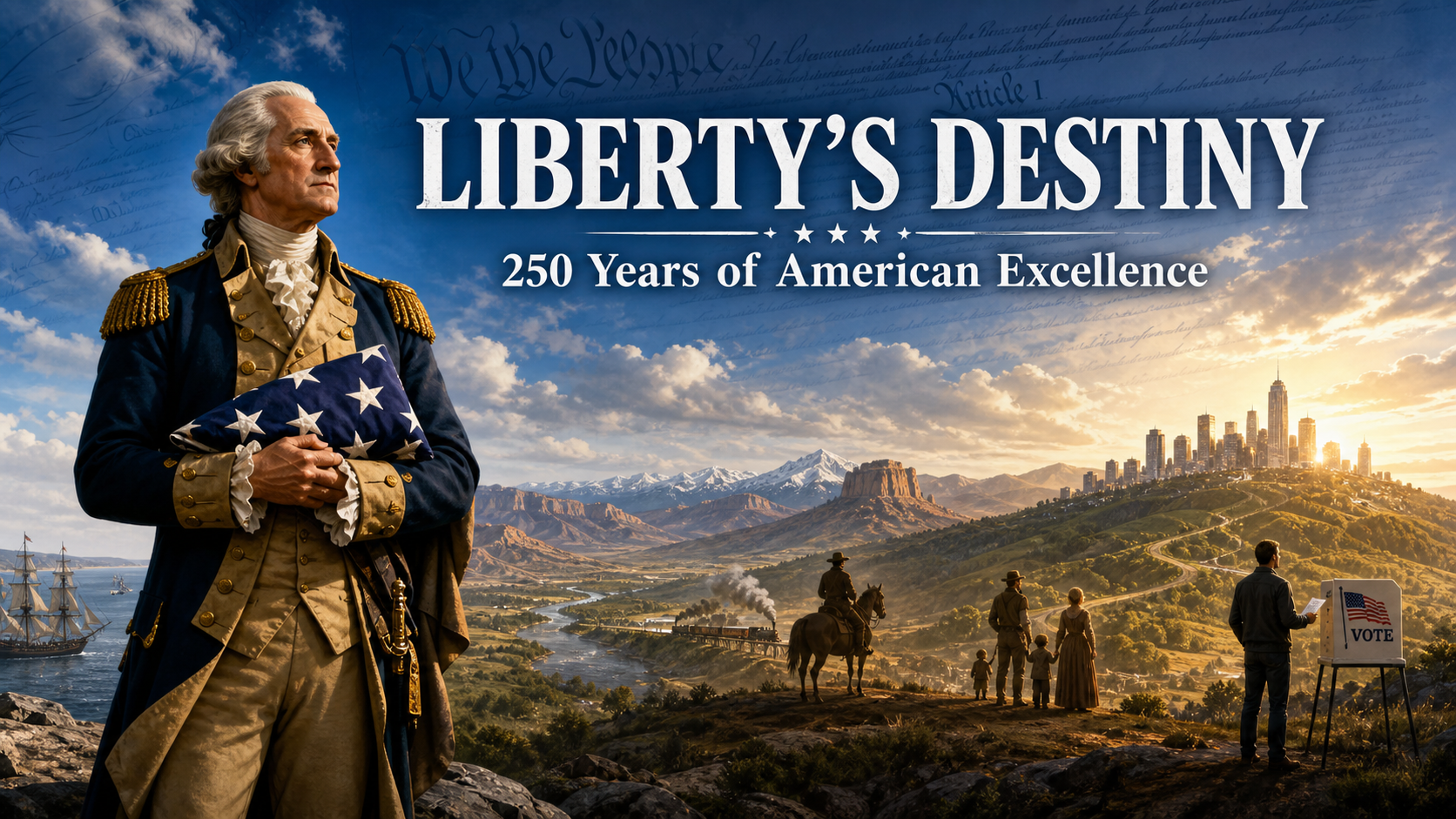
Manifest Destiny, Liberty, and the Burden of Self Government
At 250 years, the American experiment remains astonishing not because it has been flawless, but because it has endured, adapted, and renewed its covenant with liberty through war, expansion, upheaval, and reform. The United States began with a revolutionary claim that political power must answer to the people and that freedom must be secured through constitutional order rather than inherited rule (Miller Center, n.d.). A nation may be born in passion, yet it survives only through discipline, memory, and the capacity to master itself.
That is one reason the American story still commands attention. The country has passed through civil war, territorial expansion, industrial transformation, global conflict, and cultural strain while preserving a constitutional framework that places limits on power and recognizes liberties that precede the state (Miller Center, n.d.). A clear example appears in the Bill of Rights. Freedom of speech, freedom of religion, and the right to keep and bear arms were not treated as gifts handed down by rulers. They were acknowledged as liberties government must respect. “No man is free who is not master of himself” (Epictetus, as cited in Neologikon, 2017). Private disorder eventually becomes public dependence.
American excellence therefore rests not only on institutions, but on character. Citizens who cannot govern appetite, fear, resentment, or sloth will gradually ask government to do for them what they should do for themselves. A republic declines when self command gives way to comfort. It survives when men and women accept that liberty is both inheritance and burden. For that reason the endurance of the United States reveals something greater than administrative success. It reveals a people repeatedly called to moral seriousness.

Manifest Destiny and National Purpose
Manifest Destiny was one of the boldest and most revealing expressions of that national seriousness. It is defined as the belief in the supposed inevitability and divinely ordained right of the United States to expand westward to the Pacific and beyond, a view used before the Civil War to justify acquisitions in Texas, Oregon, New Mexico, and California (Britannica, 2026a). John L. O Sullivan first used the phrase in 1845 and connected it to “the great experiment of liberty and federated self government” entrusted to the American people (Britannica, 2026a). The language is important because it shows that Manifest Destiny was never only about land. It was about purpose, civilizational confidence, and the conviction that the American order possessed meaning beyond itself.
In historical terms, Manifest Destiny joined several claims in one doctrine. It held that American institutions were superior to older political forms, that westward movement was natural and even inevitable, and that continental space offered room for settlement, enterprise, and local self rule (Britannica, 2026a). The doctrine took visible form in the annexation of Texas, the settlement of the Oregon dispute, and the gains that followed the Mexican American War, through which the United States acquired an immense western domain including present day California, Nevada, Utah, Arizona, and New Mexico (Britannica, 2026a). Newspaper editors and public leaders often described these developments not merely as acquisition, but as the spread of republican life. That confidence carried force because it touched a real feature of the American mind. A free people does not naturally think in terms of confinement.
At its best, Manifest Destiny reflected courage under uncertainty. Continental growth demanded hardship, sacrifice, migration, danger, and the willingness to move into conditions no one could fully control. That pattern fits an ancient truth about serious nations and serious men. “The impediment to action advances action. What stands in the way becomes the way” (Marcus Aurelius, as cited in Christopher Cloos, n.d.). The wilderness, the mountain pass, the raw settlement, and the unbuilt frontier did not merely block American energy. They summoned it. What appeared as obstacle became the field in which national character took visible form.
Yet Manifest Destiny was never morally innocent. Britannica notes that expansion intensified conflict, worsened relations with neighboring peoples and nations, and contributed to the dispossession and forced removal of Native peoples, including the Cherokee on the Trail of Tears (Britannica, 2026a). This reveals one of the hardest truths in the American story. A nation may speak the language of liberty and still fail to honor liberty in full. That fact does not justify contempt for the nation. It demands honesty. Only a childish patriot refuses moral examination. A mature patriot does something harder. He loves his country enough to judge it by its highest principles.
That judgment, however, should not collapse into self hatred. The same doctrine that carried grave moral failures also expressed a real and durable national energy. Americans believed that free citizens could build homes, towns, churches, farms, schools, and local institutions wherever courage and labor carried them (Britannica, 2026a; Britannica, 2025b). Daniel Boone became an early symbol of this frontier drive through his work blazing trails through Cumberland Gap and helping open the way into Kentucky (Britannica, 2025b). Boone matters not simply because he moved westward, but because he accepted hardship as the price of enlarging the realm in which free life could take root.

The Shining City and the Frontier Spirit
Manifest Destiny also belongs to the larger American image of a shining city upon a hill. That image points to example. It suggests a people called to live in such a way that others see in them the possibility of ordered liberty. The shining city concerns visibility. Manifest Destiny concerns movement. Together they reveal a national conviction that the United States is meant not merely to survive, but to build, to enlarge, and to stand as visible proof that self government can endure in a dangerous world.
This point matters because ambition by itself is never enough. Ambition without discipline becomes vanity. Power without inner restraint becomes predation. National greatness requires a people able to distinguish what they can command from what they cannot. The old handbook of moral discipline begins with that distinction. “Some things are in our control and others not” (Epictetus, trans. 2008, p. 1). A republic cannot control every storm in history. It can control whether it meets trial with courage or with surrender. It can control whether it remembers its inheritance or wastes it.
The modern frontier is therefore not only territorial. It is moral, cultural, technological, and spiritual. The question is not whether Americans still possess land enough, but whether they still possess nerve enough. The same people who once crossed mountains and deserts must now cross decadence, confusion, and forgetfulness. The frontier has moved inward as much as outward. The burden remains the same. A free people must prove worthy of freedom.

Exemplars of the American Spirit
No American stands closer to the foundation of the national spirit than George Washington. His leadership during the Revolution and the fragile early years of the republic gave the new nation not only victory, but credibility and form (Miller Center, n.d.). The most revealing measure of his character came not in battle, but in restraint. At the end of the war, he surrendered his military commission and returned to private life instead of holding power by force, and later he left the presidency voluntarily rather than clinging to office (Miller Center, n.d.). Those acts taught the country that it would be governed by law and institutions, not by a permanent strongman.
Even observers abroad recognized the magnitude of this restraint. When King George III reportedly heard that Washington might resign his command and retire to his farm rather than seize a crown, he replied that if Washington did so, he would be “the greatest man in the world” (as quoted in numerous accounts of Washington’s life). This judgment from a monarch who understood how rarely power is surrendered freely helps explain why Washington stands as the greatest of all Americans. He was a victorious general who refused to become a king, a head of state who chose limitation over dominion, and a founder who placed the republic above his own ambition.
Washington’s life illustrates a hard truth about liberty. Free government does not survive on clever constitutions alone. It survives when those who possess power choose principle over appetite. He showed that real greatness is not merely the ability to command others, but the willingness to command oneself. That pattern set the moral tone for the American experiment. Every later appeal to the Constitution, to limited government, and to the rule of law rests on the precedent he established when he walked away from the chance to rule as a monarch and chose instead to live as a citizen.
Booker T. Washington represents another essential American quality, the determination to rise through labor, education, and institution building. He was an educator and reformer who was born into slavery, later led Tuskegee Normal and Industrial Institute, and became the most influential Black spokesman of his era (Britannica, 2026b). Tuskegee stands as a concrete example of disciplined construction. He helped turn a struggling school into a thriving institution and tied dignity to education, self reliance, and character formation (Britannica, 2026b). His life testified that hardship need not end in bitterness. It can be made to yield strength, skill, and enduring work.
Annie Oakley serves as a vivid symbol of frontier skill, self command, and lawful marksmanship. She was an American frontier’s woman who starred in Buffalo Bill’s Wild West show and became famous for her extraordinary proficiency with firearms (Britannica, 2025a). Her greatness did not lie in noise or spectacle alone. It lay in disciplined precision. Accuracy with a weapon is not chaos. It is control. In her life the right to bear arms appears not as lawless impulse, but as mastery governed by responsibility. She also showed that courage and excellence are not confined by sex. Competence commands respect because it answers reality directly.
Daniel Boone completes this set of exemplars by representing frontier courage in its raw form. Boone helped blaze a trail through Cumberland Gap, established frontier settlements, and became a legendary hero of early American expansion (Britannica, 2025b). His life captures the old American willingness to move toward hardship rather than away from it. The frontier was dangerous, uncertain, and demanding. Yet people crossed into it because they believed that free life required room to grow. Boone symbolizes the permanent truth that fear cannot be allowed to become sovereign.
Theodore Roosevelt reveals another side of American excellence, a powerful vision of manhood grounded in courage, discipline, and action (Brinkley, 2009). He began life as a sickly child with weak lungs and recurring illness, yet chose to rebuild himself through years of deliberate physical training, boxing, horseback riding, and outdoor hardship (Brinkley, 2009). Out of that struggle came the conviction that character must be forged, not assumed. His own body became proof of a larger principle, that strength is not an accident of birth but the result of chosen effort, and that a free nation depends on men who willingly take that path (Brinkley, 2009).
His military service stamped that conviction into history. During the Spanish American War, he resigned a comfortable post to help form the Rough Riders, a volunteer cavalry regiment that saw fierce combat in Cuba (Brands, 1997). At San Juan Hill he led from the front, riding and then charging on foot under fire, rallying his men through example rather than speech alone (Brands, 1997). Even critics of his later politics concede that his personal bravery in that campaign was unmistakable. He did not ask others to go where he was unwilling to stand.
As president he carried the same energy into public life. He broke with the passive habits of his age and insisted that the executive office must be used actively in defense of the common good, pressing for antitrust enforcement, consumer protection, and conservation of national forests and parks (Brinkley, 2009). He advanced the “Square Deal” as a vision of fair treatment for ordinary citizens and used federal power to bring powerful corporations under law instead of allowing them to function as private governments (Brinkley, 2009). His foreign policy motto that the nation should speak softly and carry a big stick expressed his belief that peace is best preserved when strength is real and visible (Brands, 1997). For him the “strenuous life” was not mere phrase. It was a summons to citizens to reject softness, self pity, and decay (Roosevelt, 1900).
What makes Roosevelt stand out, especially when measured against many politicians today, is the unity of his life. His public words, private habits, and visible actions formed a coherent whole (Brinkley, 2009). He read deeply, thought seriously, worked ferociously, and accepted risk in body and reputation (Brands, 1997). In an age when public life often rewards caution, calculation, and the careful avoidance of offense, his kind of strength is rare. Many speak of leadership while guarding their comfort above all else. Roosevelt, for all his flaws, repeatedly chose the harder road. He reminds Americans that a healthy republic needs leaders who are not only clever and persuasive but tough, self controlled, and willing to bear pain for the sake of the nation. His life illustrates again that “no man is free who is not master of himself” (Epictetus, as cited in Dobbin, 2008, p. 12), and that the same holds for nations that wish to remain free.

The Constitution
The Constitution was written with a clear understanding of human nature and the dangers that arise when power collects in too few hands. That insight explains why it has worked so well for more than 250 years. The framers did not assume that rulers would always be virtuous or that citizens would always agree; they assumed the opposite. James Madison wrote that government is necessary because humans are not angels and that those who govern must be obliged to control themselves as well as the governed (Madison, 1788/2003). This realism produced a document that balances power rather than trusting it and that sets ambition against ambition so no single person or faction can easily dominate the entire system.
One central reason the Constitution has endured is its structure of separated powers and checks and balances. By dividing authority among the legislative, executive, and judicial branches and by giving each branch tools to resist overreach by the others, the framers created a system that can correct itself without collapsing (Madison, 1788/2003). The Senate and House check one another. Congress and the president share responsibility for lawmaking and war. Independent courts can review acts that violate the supreme law of the land. This design has allowed the United States to weather crises from the Civil War to the Cold War while preserving the basic framework of representative government, because the system can bend, argue, and adapt without breaking.
Federalism is another key reason the Constitution has functioned so well. By dividing authority between the national government and the states, the document leaves room for local diversity, experimentation, and self rule while still providing a strong central government for matters such as defense, foreign policy, and interstate commerce (U.S. Const. art. I, § 8). Over time this arrangement has allowed different regions to address their own needs while still participating in a single union. When one state or locality finds a successful solution to a problem, others can learn from and adopt it. This pattern has helped the country adjust to industrialization, the growth of a national transportation network, nationwide communication technologies, and modern economic integration without the need to rewrite the entire constitutional order.
The Constitution has also endured because it combines a stable structure with a principled openness to reform. The amendment process is deliberately difficult yet not impossible, which means that fundamental changes require broad and lasting agreement rather than passing passion (U.S. Const. art. V). Through this process the nation has adopted the income tax to stabilize federal finance, established direct election of senators to strengthen democratic responsiveness, set presidential term limits to prevent personal rule, and clarified presidential succession to ensure continuity of government. At the same time the Bill of Rights and later amendments anchor core liberties such as speech, religion, due process, the right to bear arms, and equal protection in a higher law that stands above ordinary politics (Madison, 1788/2003). This combination of fixed principles and flexible mechanisms has allowed the Constitution to remain recognizable across centuries while still responding to new challenges. It was crafted as a durable framework for a free people, and its success over 250 years shows how well that design has served the American experiment.

The Future American Citizen
To be an American citizen is to inherit one of the highest callings in political life. Citizenship in the United States is not passive membership, but active stewardship of a constitutional republic built on liberty, duty, and self government. Thomas Jefferson understood that freedom survives only when the people possess the spirit to defend it, which is why this epic quote withstands the test of time, “The tree of liberty must be refreshed from time to time with the blood of patriots and tyrants” (Jefferson, 1787/1989, p. 356). The meaning of that line is not despair, but seriousness. Liberty is precious enough to demand sacrifice, vigilance, and devotion from each generation that receives it.
A mature citizen therefore recognizes that rights and responsibilities belong together. The vote, the jury box, freedom of speech, free exercise of religion, and the right to keep and bear arms are not ornaments of civic life. They are instruments through which a free people govern themselves and preserve the conditions of ordered liberty. Jefferson also wrote that “the God who gave us life gave us liberty at the same time,” expressing the belief that liberty belongs to the dignity of the human person and is not a favor bestowed by rulers (Jefferson, as cited in AZQuotes, n.d.). That thought process remains central to the American way of life. Citizens are not clients of the state. They are entrusted with the monumental purpose of sustaining a free nation.
This is why civic character matters so deeply for the future of the republic. A free country requires citizens who can govern themselves before they presume to govern public affairs. Robert Heinlein captured this idea memorably in Starship Troopers when he tied citizenship to service and responsibility, arguing that political power should be treated as a serious trust rather than a casual entitlement (Heinlein, 1987). Whatever one thinks of his fictional system, the principle carries force. Citizenship reaches its highest form when individuals understand that liberty must be earned anew in every generation through contribution, discipline, and readiness to place the common good above private ease.
In that light, the future of American greatness depends on citizens who cherish their inheritance and endeavor to extend it. Such citizens study the Constitution because they know freedom requires structure. They defend the Bill of Rights because they understand that liberty must be protected in both public law and personal habit. They raise families, build businesses, serve in religious institutions and neighborhoods, speak honestly, vote seriously, and carry themselves with the quiet confidence of a people who know what they have received. Through those acts, the country moves forward not merely in wealth or power, but in depth of character.
American greatness also depends on citizens who preserve the moral and cultural foundations of liberty with clarity and confidence. The American way of life rests on freedom of conscience, respect for law, devotion to family and community, private initiative, and the conviction that no earthly power may rightfully claim dominion over the human soul. Citizens who understand this do more than enjoy liberty. They strengthen it. They ensure that the nation remains a place where constitutional self government, religious freedom, enterprise, and lawful self defense can flourish together as parts of one coherent civilizational order.
This is the noblest way to understand America’s future and its manifest destiny. The task is not simply to occupy territory or to preserve institutions in a mechanical sense. The task is to enlarge the reach of ordered liberty across generations by forming citizens equal to freedom. Jefferson’s severe language and Heinlein’s emphasis on service both point to the same truth. A republic endures when its people see citizenship as honor, burden, and sacred trust at once (Heinlein, 1987; Jefferson, 1787/1989). When Americans take their rights seriously, bear their responsibilities willingly, and love liberty enough to defend it, the country does more than survive. It advances with strength, confidence, and purpose into its next great chapter.
References
AZQuotes. (n.d.). Thomas Jefferson quote, “The God who gave us life, gave us liberty at the same time”. Retrieved July 3, 2026, from https://www.azquotes.com/quote/845731
Brands, H. W. (1997). T. R. The last romantic. Basic Books.
Brinkley, D. (2009). The wilderness warrior Theodore Roosevelt and the crusade for America. HarperCollins.
Britannica. (2025a). Annie Oakley. Encyclopaedia Britannica. https://www.britannica.com/biography/Annie-Oakley-American-markswoman
Britannica. (2025b). Daniel Boone. Encyclopaedia Britannica. https://www.britannica.com/biography/Daniel-Boone
Britannica. (2026a). Manifest Destiny. Encyclopaedia Britannica. https://www.britannica.com/event/Manifest-Destiny
Britannica. (2026b). Booker T. Washington. Encyclopaedia Britannica. https://www.britannica.com/biography/Booker-T-Washington
Christopher Cloos. (n.d.). When the obstacle becomes the way forward, Marcus Aurelius’ Meditations 5.20. https://christophercloos.com/the-obstacle-becomes-the-way/
Dobbin, R. (2008). Epictetus Discourses and selected writings. Penguin.
Epictetus. (2008). The Enchiridion (E. Carter, Trans.). University of Colorado Boulder. https://www.colorado.edu/herbst/sites/default/files/attached-files/the_enchiridion_epictetus.pdf
Hays, R. (2014). The obstacle is the way. Portfolio.
Heinlein, R. A. (1987). Starship troopers. Del Rey. (Original work published 1959)
Jefferson, T. (1989). Letter to William Stephens Smith, November 13, 1787. In J. P. Boyd (Ed.), The papers of Thomas Jefferson (Vol. 12, p. 356). Princeton University Press.
Madison, J. (2003). The Federalist No. 51. In C. Rossiter (Ed.), The Federalist papers (pp. 320–325). Signet Classics. (Original work published 1788)
Miller Center. (n.d.). George Washington. University of Virginia. https://www.millercenter.org/president/washington
Roosevelt, T. (1900). The strenuous life Essays and addresses. The Century Co.
U.S. Const. art. I, § 8.
U.S. Const. art. V.






Leave a Reply